Federal Reserve Rate Hikes
A Federal Reserve rate hike refers to the decision by the Board of Governors of the Federal Reserve System to adjust monetary policy and raise the federal funds rate following a policy meeting in Washington.
A Federal Reserve rate hike essentially increases the borrowing rate between the Federal Reserve and commercial banks, leading to higher borrowing costs between banks (the federal funds rate). This then raises borrowing rates between commercial banks, businesses, and households, ultimately influencing investment and consumption behavior throughout society through interest rate increases.
1. FOMC Meeting Schedule
The Federal Reserve's policy meetings (FOMC meetings) are held 8 times annually in Washington, approximately 6 weeks apart.
2022 Federal Reserve Meeting and Meeting Minutes Schedule (Eastern Time)
January 25-26: Federal Reserve interest rate decision, press conference;
March 15-16: Federal Reserve interest rate decision, press conference, dot plot, economic projections;
May 3-4: Federal Reserve interest rate decision, press conference;
June 14-15: Federal Reserve interest rate decision, press conference, dot plot, economic projections;
July 26-27: Federal Reserve interest rate decision, press conference;
September 20-21: Federal Reserve interest rate decision, press conference, dot plot, economic projections;
November 1-2: Federal Reserve interest rate decision, press conference;
December 13-14: Federal Reserve interest rate decision, press conference, dot plot, economic projections.
2. Federal Reserve Organizational Structure
The Federal Reserve consists of three main components: the Board of Governors (FRB), the Federal Open Market Committee (FOMC), and 12 regional Federal Reserve Banks located in major cities across the country. These 12 reserve banks have approximately 2,000 member banks under them.
The Board of Governors consists of 7 members, composed of the Chair, Vice Chair, and 5 other members. All 7 members must be nominated by the President and confirmed by Congress before taking office. Board members serve 14-year terms, while the Chair and Vice Chair serve 4-year terms. The FOMC has 12 members, consisting of the 7 Board members and 5 of the 12 regional Federal Reserve Bank presidents selected, where the New York Fed president has a permanent vote, and the other 11 presidents take turns with 4 votes.
Board of Governors: The governing body with dominant power in monetary policy decision-making and execution, determining bank reserve requirements and reserve interest rates, and reviewing discount rates;
FOMC: The executing body that meets approximately every six weeks (policy meetings) to determine open market operations policy, i.e., the direction of monetary policy adjustments, commonly referred to as the benchmark rate. There are three adjustment directions: raising rates, cutting rates, or keeping rates unchanged;
12 Regional Reserve Banks: As important participants, they assist in executing Federal Reserve policy and providing economic market feedback.
3. Rate Hike Cycle
Based on previous Federal Reserve QE exit paths, the rate hike process can be roughly divided into four stages: First stage, releasing clear signals of reducing asset purchases; Second stage, gradually reducing bond purchases; Third stage, ending QE; Fourth stage, beginning rate hikes.
Due to changes in the broader environment, unlike the previous cycle where rate hikes began more than a year after ending QE, the market currently expects that the interval between this round of rate hikes and QE exit will be significantly shortened. Meanwhile, the Federal Reserve may reiterate that it will begin balance sheet reduction after the first rate hike, and proceed at a much faster pace than the previous cycle. The Federal Reserve explicitly stated in its December 2021 meeting minutes that "almost all members agree to begin advancing balance sheet reduction after the first rate hike" and "the appropriate pace of balance sheet reduction may be faster than during the previous normalization period."
When the Federal Reserve begins a rate hike cycle, it mainly does three things: accelerate tapering asset purchases, raise rates by increasing the federal funds rate, and reduce the balance sheet. These three actions are progressive, with each level potentially multiplying the impact.
4. Relationship Between Rate Hikes and Crypto Market Trends
The most fundamental impact of U.S. rate hikes on the crypto market is the potential to create short-term or long-term liquidity crises. The fundamental reason for the duration of such crises is: at what pace will the Federal Reserve raise rates?
Looking at the most recent rate hike cycle from December 2015 to December 2018, the Federal Reserve raised rates 9 times over 3 years. During this period, Bitcoin happened to experience its second halving and truly began to "go mainstream." During the first 5 rate hikes (December 2015 - December 2017), Bitcoin continued to rise overall, gaining approximately 100x despite the rate hikes. The subsequent 4 rate hikes were relatively more aggressive, and Bitcoin also declined continuously after reaching the second halving cycle high in late 2017, falling by over 85% at its peak.
In summary, as Bitcoin has become "mainstream" and "stock-like," changes in Federal Reserve monetary policy have an increasingly significant impact on Bitcoin's price movements, even largely determining Bitcoin's bull and bear market patterns. Simply put, from a short-term perspective, Federal Reserve rate hikes are more bearish; from a long-term perspective, rate hikes are a complex economic issue that requires specific analysis of why rates are being raised at that time, and how the economic environment and the development stage and quality of the crypto market itself are at that time.

Disclaimer
This article may contain content related to products that are not available in your region. This article is intended to provide general information only and does not take responsibility for any factual errors or omissions herein. This article represents only the author's personal views and does not represent the views of OKX. This article is not intended to provide any advice, including but not limited to: (i) investment advice or investment recommendations; (ii) offers or solicitations to buy, sell or hold digital assets; or (iii) financial, accounting, legal or tax advice. Holding digital assets (including stablecoins) involves high risk and may fluctuate significantly or even become worthless. You should carefully consider whether trading or holding digital assets is suitable for you based on your financial situation. For questions about your specific situation, please consult your legal/tax/investment professional. The information appearing in this article (including market data and statistics, if any) is for general reference only. While we have taken all reasonable precautions in preparing these data and charts, we accept no responsibility for any factual errors or omissions expressed herein. © 2025 OKX. This article may be reproduced or distributed in full, or excerpts of 100 words or less from this article may be used, provided such use is non-commercial. Any reproduction or distribution of the entire article must prominently state: "This article © 2025 OKX, used with permission." Permitted excerpts must cite the article title and include attribution, such as "Article Title, [Author Name (if applicable)], © 2025 OKX". Some content may be generated or assisted by artificial intelligence (AI) tools. Derivative works or other uses of this article are not permitted.
Show More
Recommended Reading

2025 KOLs' Most Used OKX Products: A Comprehensive Roundup
In the cryptocurrency industry, professional players' choices are always direct and pure. In 2025, KOLs have cast the most genuine votes for industry tools and ecosystem development with a full year of capital investment and time dedication. Focusing on four core questions—"What was the biggest achievement this year?", "Given that achievement, what OKX product did you use most and like best in 2025?", "Why do you like it?", and "This
January 5, 2026

2026 Investment Outlook: Asset On-Chain, Intelligence and Privacy | OKX Annual Review
Three major trends for the future of crypto: asset transformation, entity transformation, and rule transformation. As we approach 2026, bidding farewell to the past four years of infrastructure focused on "road building," the crypto industry is welcoming a profound paradigm shift. OKX Ventures defines this as the opening of the "Kinetic Finance" era, where the core is no longer how fast the network is, but the flow of on-chain assets and value generation
December 31, 2025

Voting with Data: Insights into 2025's Popular Trading Products | OKX Annual Review
If you only look at market trends, it's hard to explain the differences in returns among trading users in 2025. What truly determines returns also depends on account-level operational methods, not just market volatility itself. OKX's annual statement shows that mainstream coins remain the core of capital turnover and returns, supporting trading and strategy execution; emerging coins are more used to amplify volatility and provide staged opportunities, but are not a stable, long-term source of returns. What truly consistently contributes returns,
December 30, 2025
Fusaka in Practice: What Does Ethereum's Latest Upgrade Mean for L2s, Nodes, and Users?
Ethereum mainnet has completed the Fusaka fork. From a protocol level, this upgrade mainly includes four components. The full text presents the core insights and frontline experience of three guests in Q&A format: Ahmad (@smartprogrammer) – Nethermind execution client / Ethereum core developer Manu (@manunalepa) – Prysm / Of
December 16, 2025
OKX Research | Why Did RWA Become a Key Narrative in 2025?
RWA (Real World Assets) is becoming a global capital "favorite." Simply put, RWA brings valuable, ownership-backed items from the real world—such as traditional financial assets like houses, bonds, stocks, and even assets that are typically difficult to trade directly like artwork, private lending, and carbon credits—onto the blockchain, turning them into tradeable, programmable crypto assets. This way, not
November 20, 2025
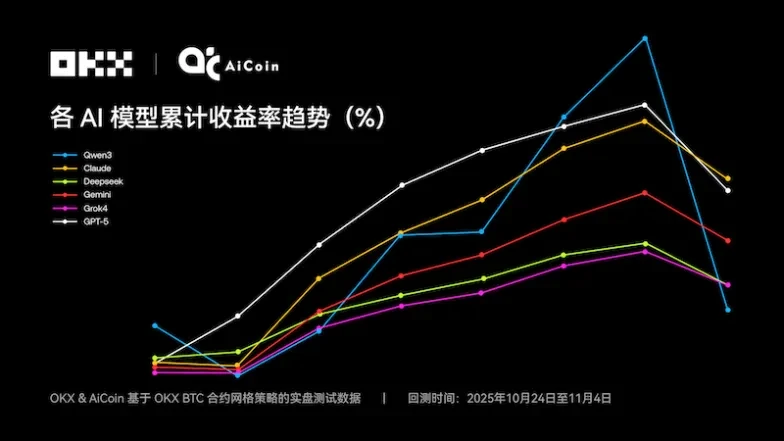
Claude Takes the Championship, Truth About 6 Major AI Grid Strategy Showdowns | OKX & Ai Coin Live Trading Test
Short-term trading champion Qwen3—is it also a king in grid strategies? The first season of the "AI Trading Live Arena" launched by NOF1 finally concluded at 6 AM on November 4, 2025, whetting the appetite of the crypto, tech, and finance communities. But the outcome of this "AI IQ public test" was somewhat unexpected—six models with a total principal of $60,000 had only $43 remaining
November 6, 2025