Fed Rate Hikes (Part 4): How Do They Affect Crypto Market Rise and Fall and Bull-Bear Transitions?
Since the Federal Reserve signaled it would raise interest rates last November, the crypto market has been falling for four consecutive months. And in about four more days (Eastern Time March 15/16), the Fed's second FOMC meeting of 2022 will be held. The market widely expects rate hikes to be implemented at this meeting. Against this backdrop, the crypto market continues to trend lower.
It can be said that at this stage, with Bitcoin's "mainstreaming" and "stock market-ization," changes in Federal Reserve monetary policy are having an increasingly significant impact on the rise and fall of Bitcoin and the crypto market, even largely determining Bitcoin's bull and bear patterns. So, in 2022, as the Fed begins its rate hike cycle, how will this affect the crypto market's rise and fall and bull-bear transitions? After rate hikes begin, what impact will they have on the global economic environment, and how will this feedback into the crypto market?
I. The Rate Hike Cycle Will Begin - What Changes Will Occur in the Overall Economic Environment?
In 2022, when Fed rate hikes are a foregone conclusion, the most important question now is: once the Fed begins its rate hike cycle, what impacts will it bring? Especially what impacts on the overall economic environment? After all, the economic base determines everything.
To answer this question, we first need to understand what is the essence of Fed rate hikes? We answered this question in a previous OKX Academy article: "Fed Rate Hikes (Part 2): What is the Essence of Rate Hikes?": The essence of rate hikes for the United States internally is developing the US economy through monetary policy adjustments, while externally it objectively evolves into financial harvesting by the US of other countries/regions and specific industries, and these two results complement and cause each other.
To achieve the above results, the Federal Reserve will use its status as the world's sole superpower to take a series of measures after and even before beginning rate hikes. These measures will cause some obvious changes in the global economic environment. Specifically, there are three main changes: accelerated global capital回流 to the US, the world entering a high inflation era, and the possibility of more black swan events like the Russia-Ukraine conflict. These three changes in the economic environment may all have significant impacts on the crypto market, or even impacts where "no egg stays intact in a overturned nest."
Change 1: Global capital begins to accelerate its flow back to the US. In the early stage of Fed rate hikes, this will be a very important phenomenon and a threat faced by the whole world. Because after US interest rates rise, capital will flow to places with higher rates for profit. At this time, to avoid significant outflows of international capital, most countries will also follow the US in simultaneously raising rates to maintain the interest rate differential between their currency and the US dollar, reducing the motivation for international capital outflows.
However, different countries have different development levels. Following the Fed in raising rates may lead to a situation where the real economy runs out of money, or burst their own asset bubbles. If they don't follow with rate hikes, capital outflows and currency depreciation may occur, with even more serious consequences. Even if choosing the lesser of two evils by selecting to follow the Fed in raising rates, you don't know how much the Fed will raise rates or at what pace. You might follow for a while before your own economy collapses.
Change 2: World inflation levels increase significantly, especially pushing up inflation in other regions, forming a value depression in the US. The core factors are energy and food price increases. Taking Europe as an example, recent sanctions on Russian oil and natural gas have already driven oil prices higher. US WTI crude oil futures once broke through $130/barrel, and the market even predicts that upcoming sanctions could send international oil prices soaring to $200/barrel. Coupled with previous sanctions on Nord Stream 2, a series of operations has successfully and rapidly raised Europe's inflation levels, and Europe didn't print less money than the US during the pandemic.
By pushing up global inflation levels, the US can make its real interest rate higher than other major economies in the first half of the rate hike cycle, thus widening interest rate differentials and increasing attractiveness to capital. The so-called real interest rate is roughly nominal interest rate + economic growth rate - inflation rate.
As the world's largest grain exporter, the US firmly controls international grain pricing power. If energy operations cannot achieve the goal, grain price operations will be the trump card that appears last.
Change 3: The probability of black swan events like regional conflicts or turmoil increases significantly. If in the early stage of rate hikes, many countries withstand the pressure, and the speed and scale of capital回流 to the US fall short of expectations, then this is the time for the US to use its superpower capabilities to create unstable situations in other regions, frightening capital so it has no choice but to flow to the US.
For example, the current Russia-Ukraine conflict is the result of constant US provocation. Anyone with eyes can see that the real purpose of the Russia-Ukraine conflict isn't both sides, but the entire eurozone. As the world's third-largest economic entity, the EU, and the euro as the second-largest international currency, only this scale can satisfy the US. Of course, the US won't put all eggs in one basket. As one of the world's three major economic poles, East Asia and Southeast Asia may also be targets, which will greatly increase the probability of black swan events in the world economy and crypto market.
It can be said that due to the massive money printing during the pandemic, the Fed has temporarily stabilized economic decline and also promoted prosperity in many markets including the crypto market. However, now it's time to harvest. The money the Fed printed out of thin air needs real assets as support, otherwise the US economy itself will collapse. The beginning of the rate hike cycle is ultimately about getting global capital to flow back to the US to support the printed US dollars. This will drain water from other countries, regions, and markets. Quality assets in other markets will all fall significantly, then Wall Street capital will strike globally, bottom-fishing global assets, completing the transition from virtual to real.
Although the US pattern is obvious to anyone with eyes, it succeeds time and again because the global community and even individual countries' internal situations aren't monolithic, plus the US superpower's political infiltration and capital hijacking, even knowing the pattern leaves one helpless, after all, internal disunity plus insufficient strength.
The US restarting rate hikes is a core matter. As a capital-supreme country, this is fighting for US core interests, so don't underestimate the US determination to fight for this or its ruthless use of any means necessary.
II. Under an Overturned Nest, How Does This Affect Crypto Market Rise and Fall and Bull-Bear Transitions?
Since last November, when the Fed clearly stated it would begin tapering and raising rates, the entire crypto market has entered a mode of endless decline. As of this writing (March 10, 2022), Bitcoin has fallen 42.99% from its historical high, and Ethereum has fallen 46.69%. Other sectors have fallen even more severely. Even as infrastructure for the entire industry, public chain projects that previously performed most brilliantly have generally fallen 50-70%, while some "old mainstream coins" like BCH, LTC, etc. have fallen 80-90%.
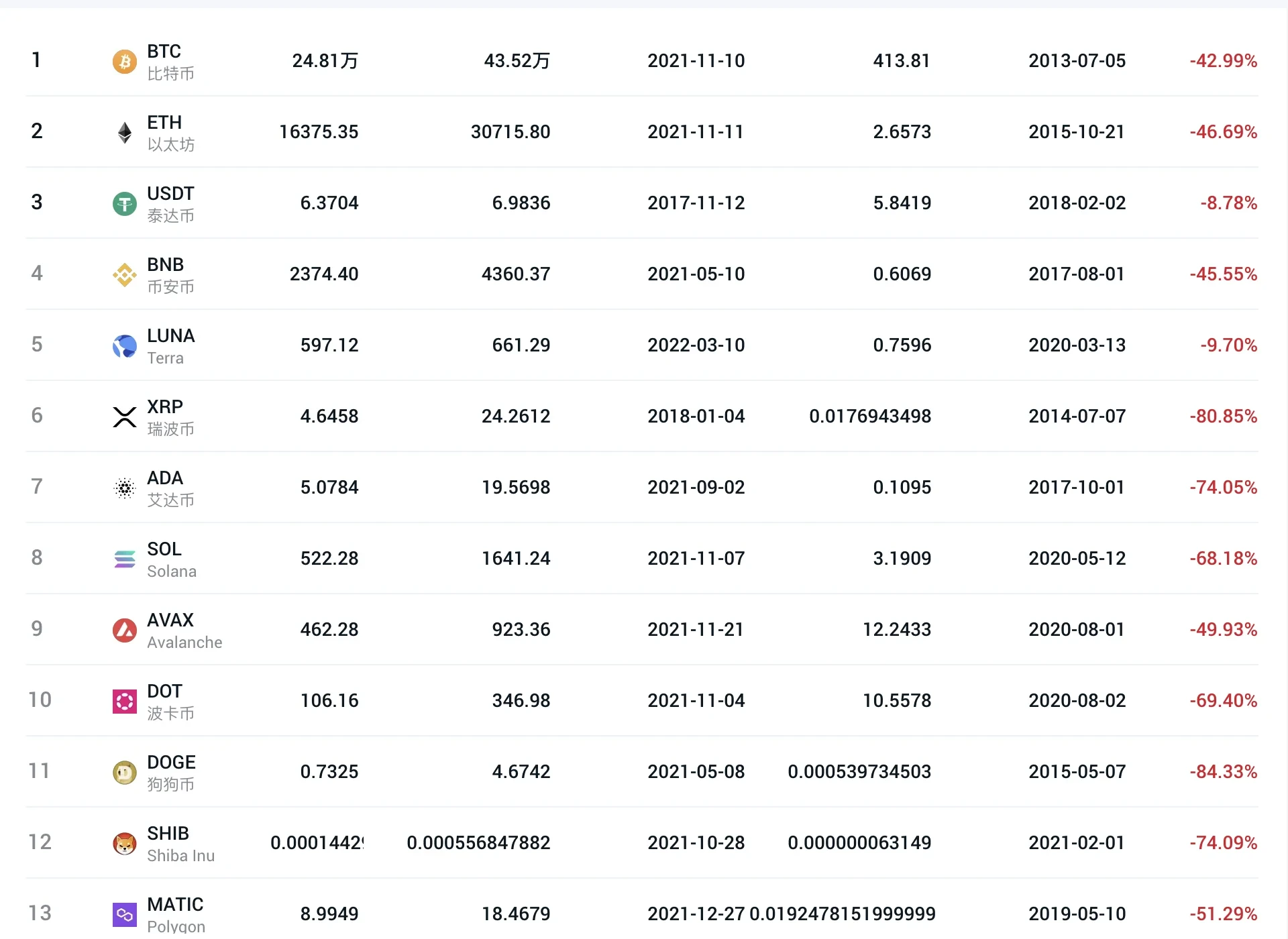
Percentage decline of some digital assets from historical highs (Source: Feixiaohao)
From the above data, we can see the crypto market's level of panic about Fed rate hikes. In summary, the impact of Fed rate hikes on crypto market rise and fall and bull-bear transitions is mainly reflected in three aspects: short-term or long-term liquidity crises caused by capital回流 to the US, impact on market sentiment, and severe price volatility caused by black swan events.
Causing short-term or long-term liquidity crises is the most fundamental impact of US rate hikes on crypto market rise and fall and bull-bear transitions. As mentioned above, Fed rate hikes will use various means to encourage global capital to flow back to the US. Most of this returning capital will flow into US Treasuries and US stock markets. Because under global tightening and increased risk, capital's primary considerations are two points: safety and return rate. From both history and reality, US Treasuries and US stock markets are the only two options that can balance both safety and return rate.
Although both US stocks and US Treasuries are currently at highs, and entering might mean catching falling knives, this is a world of comparing which is worse. If other markets fall, they might collapse directly. Capital can only choose through comparison. Moreover, for investors, US stocks relate to US national destiny. They're in it, of course they won't think the US has any major problems. They'll think that at least as the world's strongest power, even if the world collapses, the US will be the last to fall. This is the biggest misunderstanding caused by different perspectives.
If after Fed rate hikes, global capital accelerates its flow back to the US, the scale of US Treasuries and US stocks will gradually drain liquidity from other markets. Looking at scale, US Treasuries are now $30 trillion, US stocks are as high as over $50 trillion, while the crypto market's total market cap peak was $3 trillion at the end of last year - completely not in the same tier. Now Fed rate hikes haven't even been implemented, and the crypto market only has $1.74 trillion left, having lost $1.26 trillion, nearly half its market cap disappearing. For any investment market, losing liquidity is a catastrophe, and the crypto market is no exception.
Subsequently, when Fed rate hikes are implemented and quantitative tightening even begins, global capital will accelerate its回流. As a small pool beside the ocean, the crypto market might be quickly drained unless the crypto market's development speed and quality are strong enough to form a small but beautiful self-loop, and bubbles have been squeezed as much as possible. But even then, it will suffer greatly.
Fed rate hike expectations will make the entire market start showing risk-averse sentiment. This not only makes numerous investors cautious or even exit the market, but also causes increasing differentiation in the crypto market: assets with greater value consensus like Bitcoin, Ethereum, and projects with real ecosystems and application launches might attract most funds in the crypto market, thus maintaining relative strength or even rising during rate hike intervals.
Most growth projects that may have future value, however, might enter an endless decline mode after losing capital nourishment; other projects completely without market capability and users will face collapse as the final result. Market differentiation has actually already begun, and the effect is obvious - we can see clues from the "decline from historical highs" mentioned above.
Market survival of the fittest is ruthless. Only projects that can withstand market shocks and navigate through bulls and bears are qualified to survive and welcome a brilliant future. From this perspective, the great reshuffling of the crypto market caused by this Fed rate hike cycle might be an opportunity for investors, letting us know which projects truly have value. After all, only when the tide goes out do we discover who's been swimming naked.
Severe price volatility caused by black swan events will be unavoidable in the crypto market during the Fed rate hike cycle, and the frequency might be quite high, just like the big rises and falls caused by this Russia-Ukraine conflict.
Beyond the US artificially creating conflicts globally, making capital lose security and flow back to the US, causing black swan events to spill over into the crypto market. The beginning of the Fed rate hike cycle will also detonate many internal contradictions in countries/regions and markets, thereby generating self-destructive black swan events, just like in history: the 2008 global financial crisis, the tech internet bubble at the turn of the century, and the last century's Southeast Asian financial crisis caused by Fed rate hikes.
Of course, the impact of these black swan events on the crypto market isn't entirely negative. For example, the Turkish lira's massive depreciation and the Cyprus crisis caused some people to turn to Bitcoin and other digital assets. But the violent rises and falls when black swan events occur will cause many investors to suffer asset damage or even go to zero when caught off guard.
From a philosophical perspective, internal causes are the fundamental cause of development, while external causes work through internal causes. The bubbles that Fed rate hikes can burst are definitely those with their own development problems, especially those areas where bubbles were infinitely spawned during the pandemic's massive money printing - highest risk.
The crypto market to some extent fits the above situation. During this massive money printing, the crypto market grew rapidly, looking prosperous, but bubbles were also spawned massively. As the Fed begins rate hikes, these bubbles will inevitably burst. However, from a long-term perspective, the bursting of bubbles might not necessarily be a bad thing.
It's just that as a mirror of real-world assets, whether digital assets will collapse together when the real world collapses, or become a refuge for some real-world assets, remains for time to tell.
Finally, today's world faces "changes unseen in a century." Whether it's the profound adjustment of the current international landscape and international system, the profound transformation of global governance systems, or the exhaustion of "old" tech dividends and the gradual emergence of new technologies, the contradiction outbreaks caused by the overall global economic stagnation and slowdown will gradually manifest in future time.
As a small boat in the ocean, and us as droplets falling on this small boat, the crypto market has no choice but to open our arms to embrace change and embrace the storm, because retreating never leads to a bright future.
Disclaimer
This article may contain product-related content not applicable to your region. This article is intended only to provide general information and is not responsible for any factual errors or omissions herein. This article represents only the author's personal views and does not represent OKX's views. This article is not intended to provide any advice, including but not limited to: (i) investment advice or investment recommendations; (ii) offers or solicitations to buy, sell or hold digital assets; or (iii) financial, accounting, legal or tax advice. Holding digital assets (including stablecoins) involves high risk, may fluctuate significantly, and even become worthless. You should carefully consider whether trading or holding digital assets is suitable for you based on your financial situation. For questions about your specific situation, please consult your legal/tax/investment professional. The information appearing in this article (including market data and statistics, if any) is for general reference only. Although we have taken all reasonable precautions in preparing these data and charts, we accept no responsibility for any factual errors or omissions expressed herein. © 2025 OKX. This article may be reproduced or distributed in full, or excerpts of 100 words or less from this article may be used, provided such use is non-commercial. Any reproduction or distribution of the entire article must also prominently state: "Copyright © 2025 OKX. Used with permission." Permitted excerpts must cite the article name and include attribution, for example "Article Name, [Author Name (if applicable)], © 2025 OKX". Some content may be generated or assisted by artificial intelligence (AI) tools. Derivative works or other uses of this article are not permitted.
Show More
Recommended Reading

2025 KOL Most Used OKX Products Ranking Grand Review
In the cryptocurrency industry, professional players' choices are always direct and pure. In 2025, KOLs used a full year of capital investment and time accumulation to cast the most genuine votes for industry tools and ecosystem development. We围绕 four core questions - "What was the biggest achievement this year?", "Given the achievements, what were your most used and favorite OKX products in 2025?", "Why do you like it?", "How this
January 5, 2026

2026 Investment Outlook: Asset Tokenization, Intelligence and Privacy | OKX Annual Record
Three major trends in crypto future: asset transformation, entity transformation and rule transformation. At present, about to enter 2026, saying goodbye to the past four years of "road-building" infrastructure focus, the crypto industry is welcoming a profound paradigm shift. OKX Ventures defines this as the opening of the "Kinetic Finance" era, whose core is no longer how fast the network is, but the flow and earnings of on-chain assets
December 31, 2025

Voting with Data:透视 2025 Hot Trading Products | OKX Annual Record
If you only look at market conditions, it's hard to explain the return differences among trading users in 2025. What truly determines returns also depends on account-level operational methods, not just market volatility itself. OKX annual statement shows that mainstream coins remain the core of fund turnover and return carrying, supporting trading and strategy execution; emerging coins are more used to amplify volatility and provide staged opportunities, but are not stable, long-term return sources. What truly continuously contributes returns,
December 30, 2025
Fusaka in Practice: What Does Ethereum's Latest Upgrade Mean for L2, Nodes, and Users?
Ethereum mainnet has completed the Fusaka fork. From the protocol level, this upgrade mainly contains four parts. Full text按 Q&A Show More三位 guests' core viewpoints and frontline experience: Ahmad (@smartprogrammer) – Nethermind execution client / Ethereum core developer Manu (@manunalepa) – Prysm / Of
December 16, 2025

OKX Research Institute | Why Did RWA Become a Key Narrative in 2025?
RWA (Real World Assets) is becoming the global capital "new favorite." Simply put, RWA means moving valuable, ownership-based things from the real world - like houses, bonds, stocks and other traditional financial assets, or even art, private lending, carbon credits and other assets not usually easily traded - onto the blockchain, becoming tradable, programmable crypto assets. This way, no
November 20, 2025
Claude Takes Championship, 6 Major AI Grid Strategy Showdown Truth | OKX & Ai Coin Live Trading Review
Short-term trading champion Qwen3, is it also king in grid strategies? NOF1's "AI Trading Live Arena" first season finally concluded at 6 AM on November 4, 2025, whetting the appetite of the crypto, tech and finance circles. But the ending of this "AI IQ public test" was somewhat unexpected - six models' total $60,000 principal was only $4.3 left at conclusion
November 6, 2025