
Federal Reserve Rate Hikes (Part 1): Will Rate Hikes End the Bull Market?
If we were to identify the most important "financial event" globally in 2022, the "Federal Reserve rate hikes" would undoubtedly occupy "center stage." One could say that the Federal Reserve's "whether to raise rates, how many times to raise rates, how to raise rates?" not only concerns the rise and fall of the crypto market and bull-bear transitions, but also profoundly affects everyone's job performance and income level.
When the Federal Reserve first signaled its intention to raise rates, netizens had already summarized the impacts of the Fed's last five rate hike cycles (as shown in the image below). It can be seen that every Federal Reserve rate hike triggers catastrophic consequences globally, with some regions or industries even facing existential threats.
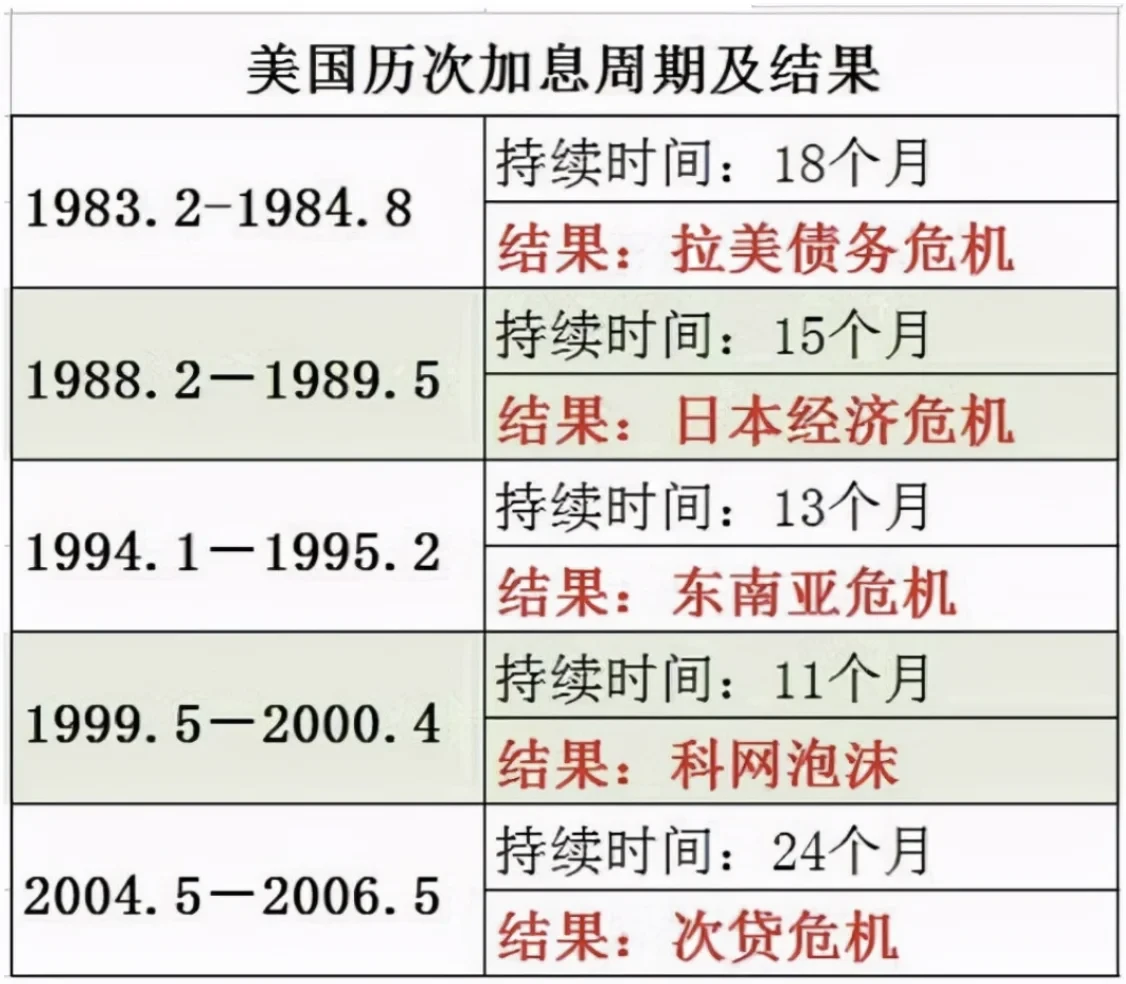
Netizens' summary of US rate hike cycles and consequences
The most recent rate hike cycle, from 2004 to 2006, triggered the subprime mortgage crisis. This was also one of the important reasons that stimulated Satoshi Nakamoto to "create" Bitcoin. Satoshi Nakamoto therefore permanently wrote that famous "news headline" in the Bitcoin genesis block: "The Times 03/Jan/2009 Chancellor on brink of second bailout for banks."
So, if the Federal Reserve starts a new round of rate hikes in 2022, what consequences will it bring to the world, and how will the crypto market be affected? Particularly under the severe inflation and liquidity glut caused by the global money printing during this pandemic, the impact of Federal Reserve rate hikes may be more extensive and far-reaching than previous rounds.
OKX Academy will subsequently launch a series of articles on Federal Reserve rate hikes, monitoring changes in Federal Reserve monetary policy in real time, and providing in-depth analysis of the reasons behind the policies and their potential impacts.
This article is the first in the series and will focus on these two questions: How will the market move after the Federal Reserve starts raising rates? Will the market necessarily fall when the Federal Reserve raises rates?
Reviewing History: The Relationship Between Federal Reserve Rate Hikes, Rate Cuts, and Bitcoin Price Movements
With Federal Reserve rate hikes in 2022 almost a certainty, many worry this will directly end the bull market. To be fair, this concern is reasonable because Federal Reserve rate hikes are, on a macro level, more bearish for the entire crypto market.
However, rate hikes are a complex economic issue and can be said to be one of the core issues in modern economic theory. If we were to explain this thoroughly, it might require a separate column. We'll discuss this gradually when opportunities arise. Here we'll only address one question: Will the crypto market necessarily fall when rates rise? Conversely, will it necessarily rise when rates fall?
First, the answer: Not necessarily. Actual price movements may be exactly opposite to rate cut or rate hike policies. What's more important is examining why rates are being raised or cut, and what the economic environment and crypto market's own development stage were at that time?
So from a historical perspective, how have Federal Reserve rate hikes and cuts affected Bitcoin's price movements?
On January 3, 2009, the first Bitcoin was officially mined. In the following seven years, until December 2015, due to the economic recession crisis caused by the subprime mortgage crisis, the Federal Reserve's interest rate remained at 0.25%. Bitcoin completed its development from 0 to 1. During this period, because Bitcoin was still in its early development stage and no mainstream funds had entered, Bitcoin's price movements were mainly influenced by its own halving cycle, while Federal Reserve monetary policy had relatively little impact.
Starting in December 2015, due to the Federal Reserve's sustained low interest rates, inflation gradually became serious and caused the economy to become relatively overheated. The Federal Reserve therefore raised rates nine times over three years until December 2018, raising rates from 0.25% to 2.5%. During this period, Bitcoin happened to experience its second halving and began its second halving bull market. In the first five rate hikes (December 2015 - December 2017), Bitcoin overall continued rising, climbing 100 times despite the rate hikes. The subsequent four rate hikes were relatively more intense, and Bitcoin also fell continuously after reaching the second halving high in late 2017, dropping up to 85%.
In this stage, although Bitcoin's price movements were still more influenced by its own halving, Federal Reserve monetary policy had already caused a huge impact on Bitcoin's price movements. Basically, every time the Federal Reserve announced a rate hike, Bitcoin would fall in the short term. The four intense and rapid rate hikes in 2018 directly ended the bull market.
Starting in August 2019, the Federal Reserve began cutting rates to promote economic development. By March 2020, as global panic caused by the pandemic spread, all markets worldwide experienced collapse-style declines, and the crypto market also experienced the memorable "3.12" crash. The Federal Reserve cut interest rates by 1% in one go. During this period, the Federal Reserve cut rates five times, lowering rates from 2.5% to 0.25%. Bitcoin gradually rebounded after the Federal Reserve announced a rate hike pause in March 2019 and experienced a small bull market. However, the emergence of the black swan of the COVID-19 pandemic caused Bitcoin and the entire crypto market to experience the "3.12" major crash.
In this stage, Bitcoin began to gradually gain recognition and participation from the mainstream world, causing it to increasingly move in tandem with mainstream markets. The involvement of Wall Street representative institutions and "Old Money" made Bitcoin gradually become "Americanized," gradually forming resonance with mainstream markets.
From March 2020 to present, Federal Reserve rates have remained at 0%-0.25%. Coupled with the start of Bitcoin's third halving, as we have seen, Bitcoin experienced a majestic bull market and reached its current historical high of $69,040 in November 2021. Subsequently, as the Federal Reserve gradually began tapering asset purchases and signaled the start of rate hikes, people's expectations for rate hikes became increasingly strong, and Bitcoin consequently began a mode of continuous decline.
To summarize, with Bitcoin's "mainstreamization" and "Americanization," changes in Federal Reserve monetary policy have had an increasing impact on Bitcoin's price movements, even largely determining Bitcoin's bull-bear form. The current stage of Federal Reserve monetary policy is somewhat similar to 2015, on the eve of ending QE and starting rate hikes. After 2015, Bitcoin experienced the process of a major bull market and bull-bear transition over two and a half years.
Comparing with US Stocks: Do Rate Hikes/Cuts Necessarily Cause Falls/Rises?
If we compare with history, will Bitcoin, like after the Federal Reserve rate hikes in 2015, first experience a bull market then a bear market? To answer this question, we need to first analyze Bitcoin's current situation. Compared to before, Bitcoin's fundamentals are vastly different. In our previous article: "Bitcoin's 'Americanization': Will Bull-Bear Boundaries Gradually Blur?", we already discussed that Bitcoin's fundamentals are beginning to shift toward "Americanization." So let's look at how US stocks have performed in various rate hike and cut cycles since 2009?
From third-party data, we can see that after Bitcoin's birth in 2009, US stocks have been in a bull market. Whether rates rose or fell, there were only brief small bear markets or short-term crashes caused by black swans, but fundamentally they kept rising. The reasons can be simply summarized as the following two points:
First, the impact of Federal Reserve rate hikes and cuts on fundamentals has a certain lag, and economic cycles have significant inertia. For example, when the economy is overheating and the Federal Reserve raises rates, US stocks should theoretically fall. However, from 2015 to 2018, the Federal Reserve raised rates nine times, yet US stocks kept rising, only falling slightly in the final stage. Moreover, if rates are raised because of economic overheating, then the overheating itself will cause most asset prices to rise.
Second, US stocks themselves benefited during this period from the rapid growth of many tech companies, such as Facebook, Amazon, Apple, Netflix, Google, etc. Their own development was sufficiently high-quality to offset the adverse effects of Federal Reserve monetary policy.
Of course, simple rigid analogy or comparison may not necessarily yield correct conclusions. We still need to analyze specific problems specifically. Returning to Bitcoin and the crypto market, we also need to analyze specifically from two aspects:
From the current economic environment, since the major outbreak of the pandemic in 2020, the global economy has suffered huge impacts. Therefore, central banks represented by the Federal Reserve opened the floodgates of money printing. While this was beneficial for economic recovery and development, it also brought serious inflation. Therefore, the reason for the Federal Reserve's upcoming rate hikes cannot be entirely attributed to economic overheating; curbing inflation is also an important objective. Moreover, current global economic development is not particularly healthy, appearing more like a prosperity bubble blown up by infinite money printing. This bubble has reached a point where it must be squeezed. The key now is how to squeeze the bubble? If rate hikes are intense and the bubble is squeezed too quickly, all markets will be affected, and Bitcoin and the crypto market will be no exception. If rates are raised slowly to achieve a soft economic landing, then it depends on whether Bitcoin and the crypto market themselves are strong enough.
From Bitcoin and the crypto market's own development situation, during this halving cycle, the entire market has undergone major development from quantity to quality. Whether it's the prosperity of DeFi, the gradual maturity of public chains, or the breakout of NFTs and the explosion of the Metaverse and Web3, all indicate that the entire industry is in a high-growth stage. So can this high growth offset the negative impact of Federal Reserve rate hikes? In summary, going forward, the development speed and quality of Bitcoin and the entire crypto market itself, and whether they can ultimately offset the negative impact of rate hike policies by central banks represented by the Federal Reserve, will be key factors in whether the crypto market can continue a bull market, or even a long-term bull market. After all, iron must be hard itself.
Finally, this article is for reference only and does not constitute investment advice. Markets involve risk; please be cautious when entering the market.
Disclaimer
This article may contain product-related content that is not applicable to your region. This article is intended only to provide general information and does not accept responsibility for any factual errors or omissions contained therein. This article represents only the author's personal views and does not represent the views of OKX. This article is not intended to provide any advice, including but not limited to: (i) investment advice or investment recommendations; (ii) offers or solicitations to buy, sell, or hold digital assets; or (iii) financial, accounting, legal, or tax advice. Holding digital assets (including stablecoins) involves high risk, may fluctuate significantly, and may even become worthless. You should carefully consider whether trading or holding digital assets is suitable for you based on your financial situation. For questions about your specific situation, please consult your legal/tax/investment professional. The information appearing in this article (including market data and statistics, if any) is for general reference only. Although we have taken all reasonable precautions in preparing these data and charts, we accept no responsibility for any factual errors or omissions expressed herein. © 2025 OKX. This article may be reproduced or distributed in its entirety, or excerpts of 100 words or less from this article may be used, provided that such use is non-commercial. Any reproduction or distribution of the entire article must also prominently state: "© 2025 OKX. Used with permission." Permitted excerpts must cite the article name and include attribution, for example "Article Name, [Author Name (if applicable)], © 2025 OKX". Some content may be generated or assisted by artificial intelligence (AI) tools. Derivative works or other uses of this article are not permitted.
Show More