NFTs Cannot Yet Fully Realize the Metaverse Vision—Let's Start by Addressing These Urgent Issues
In 2021, in the crypto assets sector known for its rapidly shifting trends, NFTs emerged from major events like Ethereum 2.0, the Bitcoin Taproot upgrade, Layer 2, EIP-1559, and slot auctions to become the industry's most closely watched sector.
There are numerous data points that break market perceptions, along with well-known breakout events, showing us the impressive achievements NFTs have made during their strong rise:
Beeple's NFT work "Everydays: The First 5000 Days" sold for a staggering $69.3 million; the FeistyDoge NFT set an industry-high price of nearly $130 million through ownership fractionalization; Crypto Punks' daily trading volume surpassed $142 million; NFT trading platform OpenSea's August trading volume exceeded $3.4 billion, a month-over-month increase of over 1100%...Visa, Coca-Cola, Porsche, LV, Audi, Marvel, Burberry, and other well-known companies and brands have also entered the NFT market in various forms.
However, behind the excitement of giants rushing in and funds surging, it's not hard to spot some problems exposed by NFTs.
Multiple Data Points Decline, NFT Market Heat Cools
The inevitable decline after a period of extreme prosperity seems to have become an unbreakable rule in the industry, and the NFT market is no exception. After explosive growth driven by multiple waves, the NFT market began a comprehensive cooling in mid-September with multiple data points declining. According to OK Link data: NFT market daily trading volume and daily trading numbers both peaked in late August: daily trading volume reached as high as $297 million, with 21,700 trades. Then they began to gradually decline. As of September 29, NFT market daily trading volume was $40.61 million, down 80.1% from the high, and daily trading numbers were 4,377, down nearly 80% from the high.
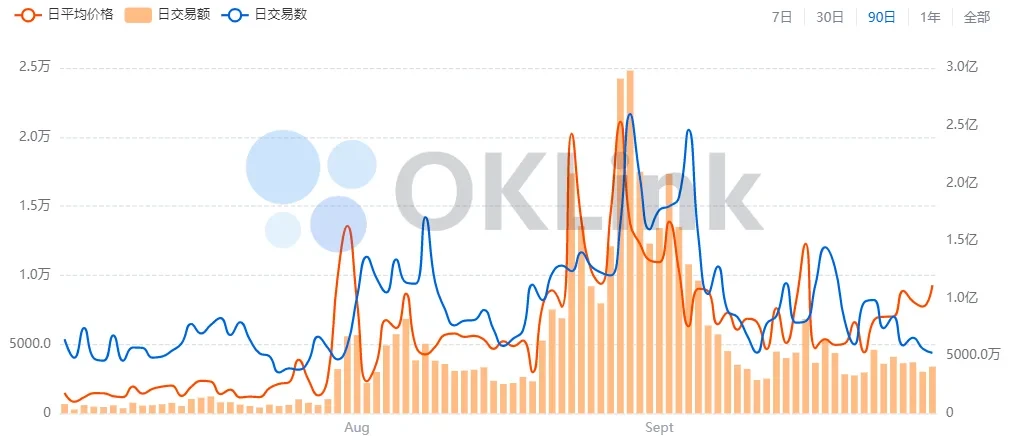
NFT market trading situation, image source OK Link
Accompanying the overall market cooling, leading NFT projects also showed varying degrees of decline:
First let's look at BoredApe Yacht Club (abbreviated as BAYC), an NFT collectibles project launched around late April this year. This series consists of 10,000 unique apes and contains 170 attributes of varying rarity. On August 28, well-known NBA star Stephen Curry purchased a BAYC NFT work for 55 ETH (approximately $180,000) and set it as his social media avatar. This move brought massive attention and capital inflow to BAYC. On that day, BAYC ape trading volume reached around $56 million, a month-over-month increase of over 400%. However, according to cryptoslam data, BAYC's metrics then began to show significant declines, with low-point trading volume less than $1.5 million.
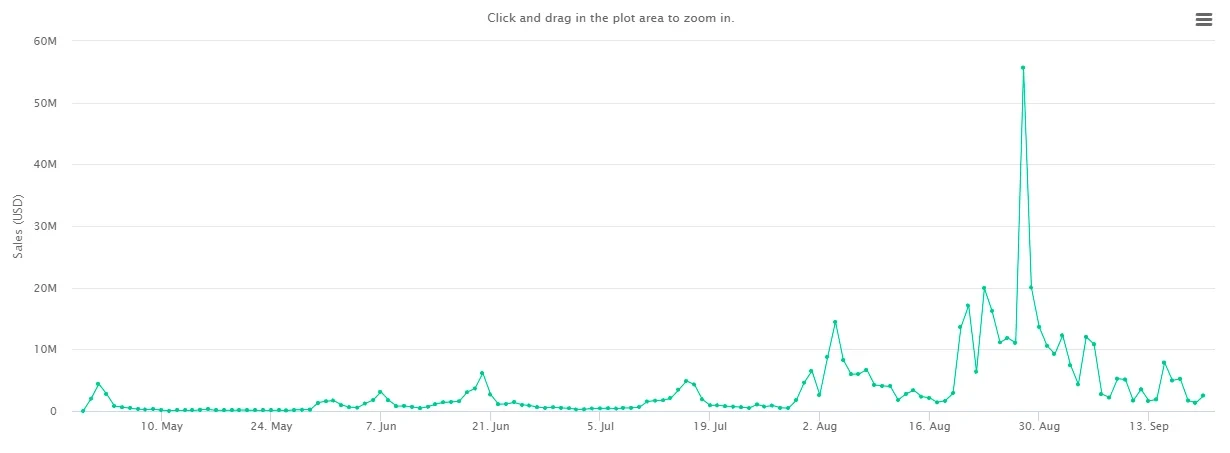
BoredApe Yacht Club trading volume trend, image source cryptoslam
Another leading NFT project, Crypto Punks, also showed significant declines across multiple metrics. According to OK Link data: On September 29, Crypto Punks' daily trading volume was $10.13 million, down 92.9% from the high of $142 million (on August 28). Active user count and trading numbers were 76 and 21 respectively, down 90% and 94% from their highs. Other well-known NFT projects like Meebits, Loot, and Cool Cats also showed varying degrees of cooling and shrinking metrics.
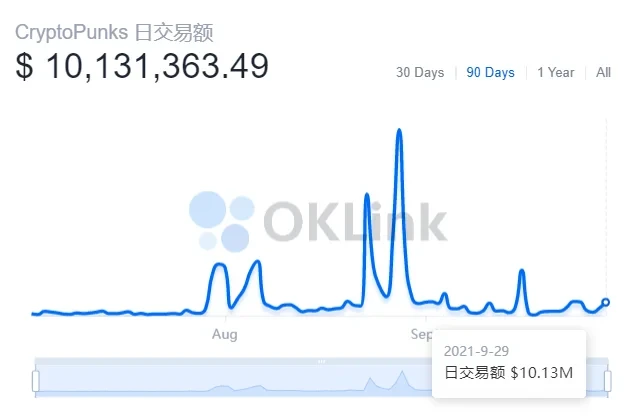
Crypto Punks daily trading volume change trend, image source OK Link
NFTs' meteoric rise can be attributed to three factors:
First, after long-term development and accumulation, the crypto industry's infrastructure, capital scale, overall environment, and user maturity have all improved significantly. Progress in all areas provided a solid foundation for NFTs' explosive growth.
Second, compared to traditional fungible assets, NFTs' non-fungible, indivisible characteristics make it easier to create provable scarcity and seamlessly combine with art, music, collecting, and other fields, thus gaining favor from institutions, brands, and celebrities. Continuous capital involvement and celebrity participation have driven NFTs to grow at a pace that constantly刷新认知.
Third, this year, the metaverse has once again become a scorching hot concept. And NFTs are indispensable building blocks for constructing the metaverse, carrying people's longing for a parallel world. If the metaverse is an inevitable trend of digital development, then NFTs will inevitably rise along with it.
But currently, the metaverse still has a long way to go, and NFTs are not perfect. Behind their explosive growth lie several hidden concerns.
How to Break the Liquidity Constraint?
Relative lack of liquidity is a problem the current NFT market cannot avoid:
First, NFTs are non-fungible assets, meaning a single NFT work from the same series is often the smallest trading unit. Prices often running into hundreds of thousands or even millions of dollars deter many users who want to participate. High floor prices and Gas fees, relatively more complex interaction processes, and the lack of relatively fair and scientific pricing mechanisms all prevent NFTs from being traded with low cost and high speed like Bitcoin and other traditional digital assets, and can even lead to situations with prices but no buyers. These market trading pain points are also the main factors limiting NFT user base growth, because for most users, capital utilization efficiency and certainty of earning returns through price differences are important reference indicators when selecting targets. NFTs' current market reality clearly cannot meet their trading demands. Liquidity deficiencies cause NFT market heat to lose momentum after reaching a certain height.
To solve NFT liquidity problems, some teams and communities have made numerous attempts, such as NFT fractionalization similar to "stock split" mechanisms. Currently, mainstream fractionalization protocols include Fractional, NFTX, etc., while well-known fractionalization cases include: Metapurse packaging and fractionalizing 20 works from "Everydays: The 2020 Collection" plus multiple virtual properties (issuing ERC20 token B.20); and the FeistyDoge NFT ownership fractionalization.
Current NFT fractionalization solutions, while able to lower NFT market barriers to some extent and enable NFT fragments to participate in DeFi activities—helping capital accumulation and user growth and driving market-scale development—also have some problems, such as risk transfer, high correlation between artwork integrity and value, and whether floor prices and governance parameters are reasonable; besides NFT fractionalization protocols, some NFTs themselves are composed of disassemblable components or leave large extensibility space in their mechanism design, making it convenient for participants to create traffic entry points when supplementing the ecosystem.
Currently, there's no relatively complete solution for NFT market liquidity problems. Solving this development constraint has a long way to go.
How to Expand Application Scenarios?
As mentioned earlier, NFTs are regarded as indispensable basic components for building the metaverse. Because to achieve a complete digital society, we need to use NFTs' uniqueness, indivisibility, and other characteristics to create its economic system and model. But currently, talking extensively about metaverse concepts is premature.
Current NFT application scenarios are mainly concentrated in relatively niche areas like copyright, collecting, GameFi, and social networking. Limited application scenarios not only restrict possibilities for players to intersect with NFTs but also make many onlookers unable to believe in NFTs' value support. Insiders consider NFTs as the inevitable path of digital development, a revolutionary combination of blockchain technology and art. Some outsiders, however, think: NFTs are just hype greater than meaning marketing. For example: blockchain company Injective Protocol purchased the painting "Morons (White)" for $95,000, then burned it in a live stream and sold the corresponding NFT work for 4 times the price. This series of operations left many people exclaiming "I don't get it."
NFTs still need long-term accumulation and development before large-scale adoption—this is by no means something that happens overnight. So how to find more implementation directions and develop more universal application scenarios before the metaverse era truly arrives has become an important proposition for NFT market development promoters.
How to Make the NFT Market More Sound and Transparent?
Compared to fungible assets, besides their own attributes, NFTs also have characteristics like relatively small capital scale, relatively fixed trading units, lack of sound price discovery mechanisms, short development time for trading platforms, and incomplete rules. Simply put, the NFT market's rule improvement speed significantly lags behind current development speed, with many gaps that can be exploited. This means that for those with ulterior motives, greater manipulation space can be created at lower cost. For example: a certain NFT work's price can be artificially inflated through methods like placing orders and buying them oneself, creating false prosperity. Recently, a well-known NFT trading platform OpenSea product manager using position for improper gain even triggered extensive discussion about "crisis of trust."
For NFT participants, everyone urgently needs a more diverse, inclusive, and transparent trading environment under sound system protection.
If a market or industry wants to achieve long-term healthy development, it cannot avoid problems or overly rely on temporary solutions for short-term benefit. There's no denying that the NFT market has enormous development space and may one day become the key to opening the metaverse door. But without solving current problems, NFT market development will be greatly limited. Teams and platforms dedicated to solving the above problems and actually implementing solutions will also receive greater development rewards.
Disclaimer
This article may contain product-related content not applicable to your region. This article is intended only to provide general information and does not assume responsibility for any factual errors or omissions contained herein. This article represents only the author's personal views and does not represent OKX's views. This article is not intended to provide any advice, including but not limited to: (i) investment advice or investment recommendations; (ii) offers or solicitations to buy, sell, or hold digital assets; or (iii) financial, accounting, legal, or tax advice. Holding digital assets (including stablecoins) involves high risk, may fluctuate significantly, and may even become worthless. You should carefully consider whether trading or holding digital assets is suitable for you based on your financial situation. For questions about your specific situation, please consult your legal/tax/investment professional. Information appearing in this article (including market data and statistics, if any) is for general reference only. Although we have taken all reasonable precautions in preparing these data and charts, we assume no responsibility for any factual errors or omissions expressed herein. © 2025 OKX. This article may be reproduced or distributed in full, or excerpts of 100 words or less from this article may be used, provided such use is non-commercial. Any reproduction or distribution of the entire article must also prominently state: "Copyright © 2025 OKX. Used with permission." Permitted excerpts must cite the article name and include attribution, such as "Article Name, [Author Name (if applicable)], © 2025 OKX". Some content may be generated or assisted by artificial intelligence (AI) tools. Derivative works or other uses of this article are not permitted.
Show More
Recommended Reading

2025 KOLs' Most-Used OKX Products: A Comprehensive Review
In the cryptocurrency industry, professional players' selections are always direct and pure. In 2025, KOLs used their full-year capital investment and time accumulation to cast the most genuine votes for industry tools and ecosystem development. Around four core questions—"What was the biggest achievement this year?", "Given those achievements, what OKX products did you use most and like best in 2025?", "Why do you like it?", and "This
January 5, 2026

2026 Investment Outlook: Asset On-Chain, Intelligence and Privacy | OKX Annual Review
Three major trends for crypto's future: asset transformation, entity transformation, and rule transformation. As we approach 2026, bidding farewell to the past four years of "road-building" infrastructure focus, the crypto industry is welcoming a profound paradigm shift. OKX Ventures defines this as the opening of the "Kinetic Finance" era, where the core is no longer how fast the network is, but the flow of on-chain assets and making money
December 31, 2025

Voting with Data:透视 2025 Hot Trading Products | OKX Annual Review
If you only look at market trends, it's hard to explain the return differences between trading users in 2025. What truly determines returns also depends on account-level operation methods, not just market volatility itself. OKX's annual statement shows that mainstream coins remain the core of capital turnover and returns承载, supporting trading and strategy execution; emerging coins are more used to amplify volatility and provide phased opportunities, but are not stable, long-term return sources. What truly持续contributes returns,
December 30, 2025
Fusaka in Practice: What Does Ethereum's Latest Upgrade Mean for L2, Nodes, and Users?
Ethereum mainnet has completed the Fusaka fork. From a protocol perspective, this upgrade mainly includes four components. Full text Q&A Show More three guests' core viewpoints and first-line experience: Ahmad (@smartprogrammer) – Nethermind execution client / Ethereum core developer Manu (@manunalepa) – Prysm / Of
December 16, 2025
OKX Research Institute | Why Did RWA Become a Key Narrative in 2025?
RWA (Real World Assets) is becoming a global capital "new favorite." Simply put, RWA means taking valuable, ownership-bearing things from the real world—like traditional financial assets such as houses, bonds, stocks, and even assets like artwork, private lending, and carbon credits that are usually not easily directly traded—onto the blockchain to become tradeable, programmable crypto assets. This way, no
November 20, 2025
Claude Takes the Crown, 6 Major AI Grid Strategy Showdown Truths | OKX & Ai Coin Live Trading Review
Short-term trading champion Qwen3—is it also king in grid strategies? The first season of the "AI Trading Live Arena" launched by NOF1 finally concluded at 6 AM on November 4, 2025, whetting the appetite of the crypto, tech, and finance circles. But the outcome of this "AI IQ public test" was somewhat unexpected—six models' total principal of $60,000 was only $4.3 at conclusion
November 6, 2025