NFT Market Enters New Correction Phase: Will Financialization Become the New Development Direction?
In investment markets, there are moments of glory during highs and stages of silence during lows. Whether it's Bitcoin and Ethereum, the two leading giants, or NFTs, the rising stars in the cryptocurrency market in Q3 of this year.
Recently, the NFT market cooling down seems to have become an indisputable fact. First, the most intuitive feeling is that the content related to NFTs in the information we receive daily is quietly decreasing. The news of individual NFT works selling for millions or even tens of millions of dollars has decreased significantly, and the use and discussion of various NFT profile pictures on social platforms have also calmed down. Secondly, in terms of data dimensions, a very obvious cooling trend has already emerged.
Trading Volume and Trading Count Among Key Metrics All Decline, NFT Market Hits the Brakes
According to data from OK Link, since entering September, the daily trading volume, daily trading count, and daily average price in the NFT market have all experienced significant declines. On September 23, 2021, the daily NFT trading volume was approximately $18.59 million, the daily trading count was 3,037, and the daily average price was $6,124. Just one month earlier on August 29, these three metrics reached $293 million, 20,400 times, and $14,400 respectively. In comparison, the declines reached 73.2%, 85%, and 57.5% respectively.
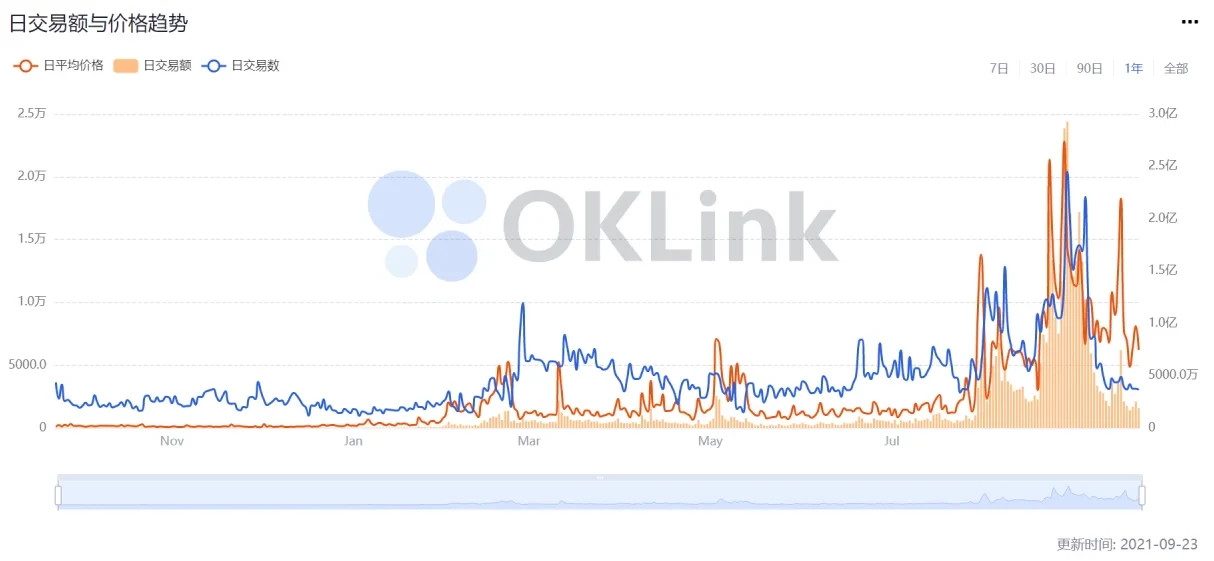
Daily trading volume and price trends in the NFT market over the past year, Source: OK Link
Let's take a closer look at several key data changes in specific market segments. First, let's look at Crypto Punks, an NFT project that has been online for 4 years and is also the first NFT project. At the peak of this NFT market cycle, the daily trading volume once exceeded $142 million. By September 23, 2021, the daily trading volume had rapidly dropped to $7.1 million, a decline of 95%. In terms of active users, it also rapidly decreased from 769 on August 29 to 98 on September 23, a drop of over 87%. The change in trading count is equally pessimistic, having shrunk from a peak of 354 times on August 23 to 19 times on September 23, a decline close to 95%. In comparison, the change in the average daily price of NFTs on Crypto Punks is somewhat more moderate. Over the past three months, not only did the peak value occur later, but the maximum decline was also smaller. Specifically, the highest daily average price for the Crypto Punks project appeared on September 11 at $940,000, while the recent lowest daily average price appeared on September 15 at $242,000, a decline of 74%.
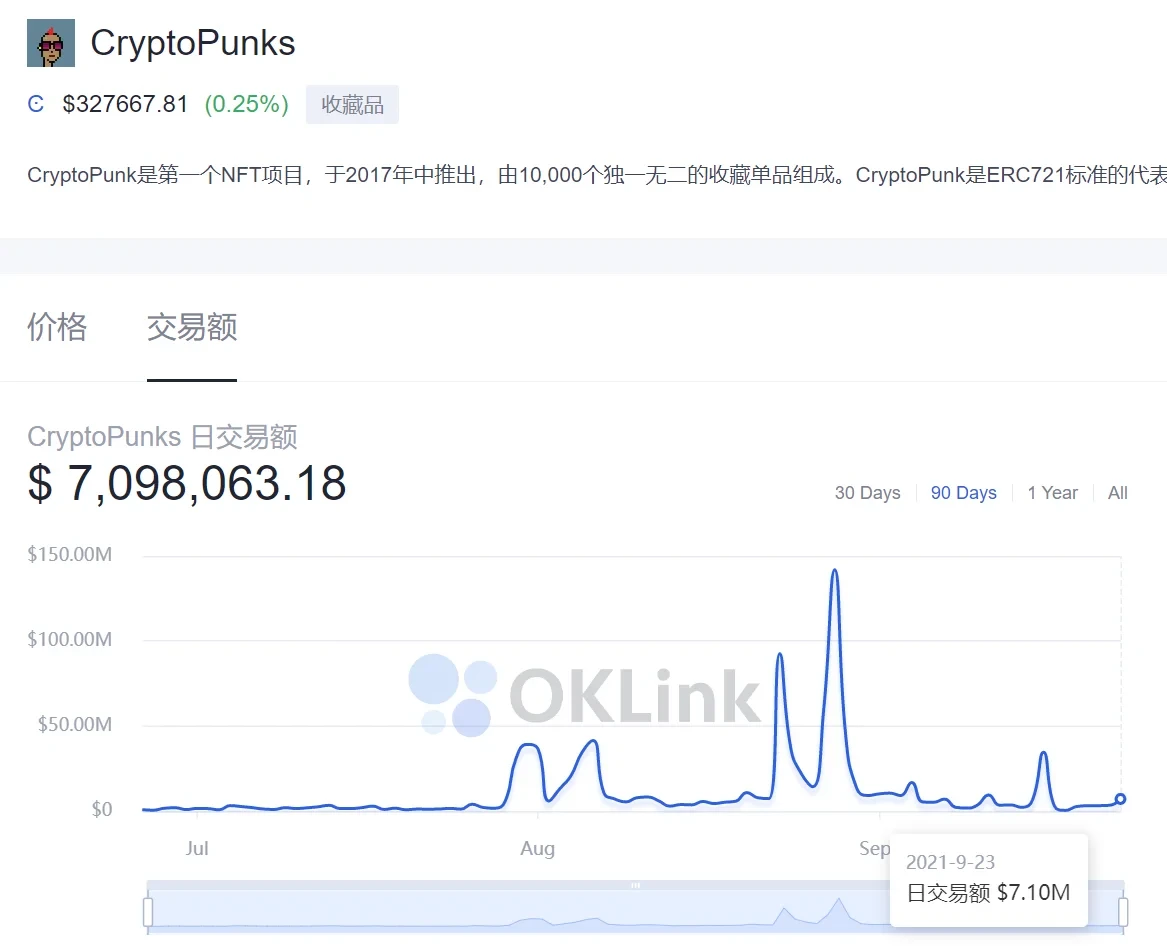
Crypto Punks trading volume changes over the past 3 months, Source: OK Link
Now let's look at Loot, which suddenly exploded in popularity. Since its launch on August 27, Loot's daily trading volume went from 0 to its peak in less than a week. On September 2, it successfully set a record for the highest daily trading volume of $60.16 million. However, by September 23, the daily trading volume had fallen to $1.39 million. On September 18, it even set a new stage low of $394,000. During this period, the maximum decline reached an astonishing 99.35%.
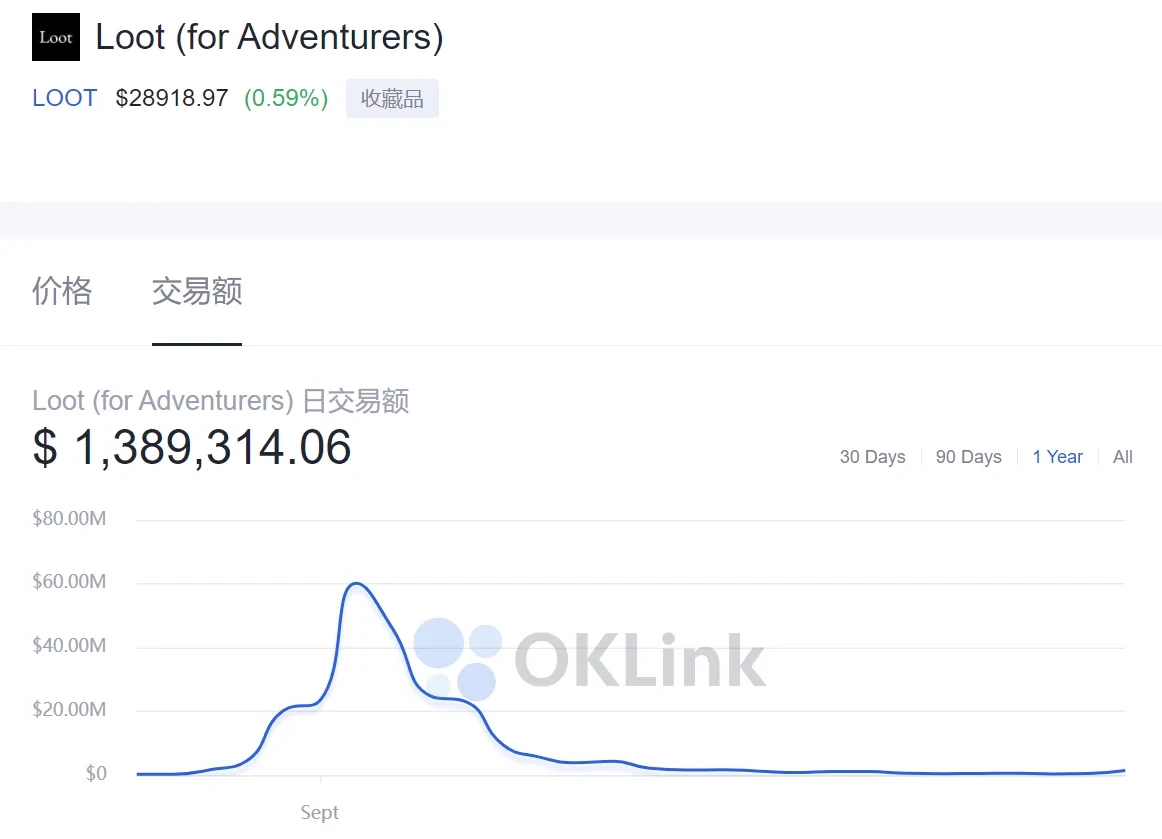
Loot daily trading volume changes since launch, Source: OK Link
In terms of active users, it also decreased from a high of 1,126 on August 28 to a low of 23, a decline close to 98%. The change in trading count was similar, shrinking from a peak of 1,245 trades per day to a low of 12 trades per day, a decline of over 99%.
From the changes in several key data points from these two representative NFT projects, it's not difficult to see that in the past half month or so, the investment sentiment in the NFT market is no longer comparable to the hot scenes of August. As the market gradually enters a cooling period, market investors are beginning to re-examine the value of NFT assets.
However, we also found that although the overall heat of the current NFT market is in a cooling trend, some newly launched high-quality projects are still objects pursued by investors in the market. For example, in the TIME Pieces series NFT blind box sales event conducted by TIME Magazine early this morning, all 4,676 NFTs were sold out within one minute. According to statistics from on-chain data analyst Banterlytics, during this buying frenzy, 22 addresses paid gas fees exceeding 10 ETH, with the highest gas fee being 22.6 ETH (calculated at ETH's price at the time, the total value exceeded $70,000). It's worth mentioning that the selling price of these NFT blind boxes was only 0.1 ETH. Additionally, according to Etherscan data, there are currently 1,822 addresses holding this series of NFTs, with the top 100 addresses holding the most NFTs accounting for approximately 24% of the total.
Furthermore, from the ranking of ETH burned on the Ethereum network, it can also be seen that whether in a 24-hour period, a week, or a month, the burn volume from the NFT market remains at the top of the list. This shows that although recent key indicators such as NFT market trading volume and trading volume have declined significantly, the funds and attention brought by the earlier large-scale outbreak have not completely withdrawn.
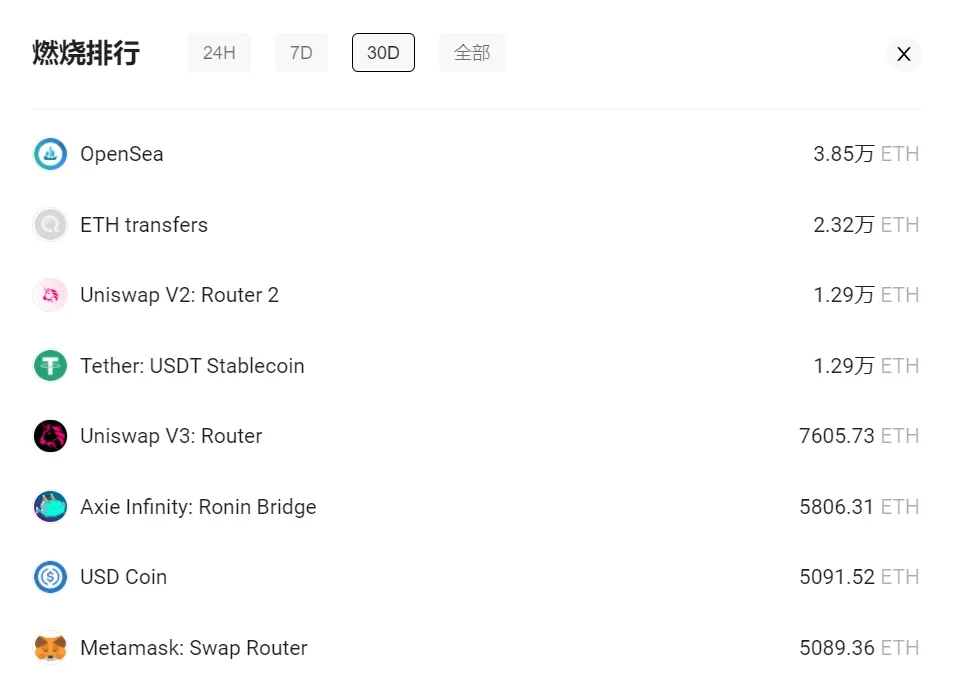
Ranking of ETH burned on Ethereum network in the past 30 days, Source: qkl123
Rethinking After Cooling: How to Solve NFT Low Liquidity?
Although since NFTs entered the vision of investors at the end of 2020, discussions and doubts about possible problems on NFT's development path have continued. Among them, the concern about the普遍 low liquidity of NFT assets is undoubtedly one of the hottest topics. At the recent node where the overall NFT market has cooled down, we might as well list this problem separately again for consideration. What were the achievements of attempts to solve NFT asset liquidity in the earlier market? What new solutions are worth trying in the future market?
As everyone knows, fundamentally speaking, NFTs are different from most crypto assets such as Bitcoin and DeFi tokens. Due to different issuance standards, NFT assets naturally possess uniqueness, indivisibility, and other attributes. This is both their advantage in closely combining with multiple fields such as artworks, cards, and collectibles, but it has also become a "stumbling block" hindering their further circulation in the secondary market. It must be acknowledged that although there are indeed players in the market whose purpose is long-term collection of NFT assets, for the majority of other players, buying low and selling high to earn the spread is their primary purpose for entering the NFT market. The non-fungible token characteristic of NFTs obviously makes such assets unable to be quickly priced by the market and quickly circulated for trading like Bitcoin. This has become a major obstacle restricting the continued activity of the NFT market. Therefore, from this perspective, low liquidity is also to a large extent an important reason why this NFT market quickly fell into silence after experiencing a short high period of 2-3 months.
In fact, NFT market participants have also been exploring feasible solutions to increase liquidity. For example, the round of "NFT fragmentation" that started in August. In the article "NFT Avatars Are So Expensive, Why Don't We 'Shatter' Them?" first published by OKX Academy, we introduced the NFD trading boom started by dividing ownership of the Feisty Doge NFT work. The Feisty Doge NFT work is based on the Feisty Doge photo. The photo was first auctioned as an NFT in June of this year and was won by a user with the Twitter name path.eth (@Cryptopathic) at a price of 13 ETH on the decentralized auction platform Zora. On August 19, the user divided the ownership and created a token NFD with a total supply of 100 billion. He then created an ETH-NFD pool on SushiSwap, investing 25 ETH and 5 billion NFD as initial liquidity, meaning Feisty Doge's initial valuation was 500 ETH (approximately worth $1.555 million at the time). Such a low price, against the backdrop of many NFT assets being unreachably high at the time, immediately ignited investors' enthusiasm. Market interest in NFD spread rapidly, rising from the initial $0.00001547 to a high of $0.00125862 on August 22, an 80-fold increase in just 3 days. As NFD soared to its high point, it also meant that Feisty Doge NFT became the most expensive NFT in the industry at a price of $126 million.
Although this fragmentation solution, similar to the "stock split" concept in traditional financial markets, helps lower the barrier for investors to enter the NFT market and increases asset liquidity, it has triggered another new problem: how to regulate ownership, decision-making power, validity, and other aspects after NFT fragmentation. If not handled properly, it will not only fail to solve the low liquidity problem but will also bring more negative impacts to this emerging market.
Will Financialization Be the New Direction for NFTs?
This is actually not a new issue. In the Uniswap V3 version launched in May of this year, not only was the concept of concentrated liquidity proposed, but also the creative integration of DeFi and NFT, proposing to use NFTs as LP tokens, equivalent to a contract signed between Uniswap and LP. Unlike before, in previous liquidity pools, LP tokens only differed in quantity. After using NFTs to represent LP tokens, LP tokens have more attributes—that is, we add more descriptions to the contract. For example, Uniswap V3 supports LPs specifying price ranges for market making. This range is one of the descriptions of that NFT "contract". The descriptiveness of NFTs gives richer imagination to DeFi financial applications. It should be noted that LP NFTs in Uniswap V3 are different from NFTs in the conventional sense we understand. They are not collectibles given to users after providing liquidity for market making, but rather represent your ownership of the deposited funds. Any user who obtains this NFT has the right to redeem the corresponding funds. This means that if you sell or transfer this NFT, your right to redeem previously deposited funds will also be transferred. From this perspective, the financialization direction seems to be a more feasible solution for improving NFT liquidity.
In this regard, Meng Yan, Vice President of the Digital Assets Research Institute, stated: Uniswap V3 has taken a key step in NFT financial applications. If crypto assets are programmable money, then Financial NFTs are automated money, smart money, and a universal tool that helps all parties establish contracts and promote collaboration.
Disclaimer
This article may contain product-related content not applicable to your region. This article is intended to provide general information only and is not responsible for any factual errors or omissions therein. This article represents only the author's personal views and does not represent the views of OKX. This article is not intended to provide any advice, including but not limited to: (i) investment advice or investment recommendations; (ii) offers or solicitations to buy, sell, or hold digital assets; or (iii) financial, accounting, legal, or tax advice. Holding digital assets (including stablecoins) involves high risk, may fluctuate significantly, and may even become worthless. You should carefully consider whether trading or holding digital assets is suitable for you based on your financial situation. For questions about your specific situation, please consult your legal/tax/investment professional. The information appearing in this article (including market data and statistics, if any) is for general reference only. Although we have taken all reasonable precautions in preparing these data and charts, we assume no responsibility for any factual errors or omissions expressed herein. © 2025 OKX. This article may be reproduced or distributed in its entirety, or excerpts of 100 words or less from this article may be used, provided that such use is non-commercial. Any reproduction or distribution of the entire article must also prominently state: "This article is copyrighted © 2025 OKX, used with permission." Permitted excerpts must cite the article name and include the source, for example "Article Name, [Author Name (if applicable)], © 2025 OKX". Some content may be generated or assisted by artificial intelligence (AI) tools. Derivative works or other uses of this article are not permitted.
Show More
Recommended Reading

2025 KOL Most Used OKX Products Ranking
In the cryptocurrency industry, professional players' choices are always direct and pure. In 2025, KOLs used a full year of fund investment and time accumulation to cast the most authentic votes for industry tools and ecosystem development. We focused on four core questions—"What was the biggest achievement this year?", "Given the achievements, what OKX products did you use most and like most in 2025?", "Why do you like it?", "This
January 5, 2026

2026 Investment Outlook: Asset On-Chain, Intelligence and Privacy | OKX Annual Record
Three major trends for the future of crypto: asset transformation, entity transformation, and rule transformation. As we are about to enter 2026, bidding farewell to the past four years of infrastructure focus on "road building," the cryptocurrency industry is welcoming a profound paradigm shift. OKX Ventures defines this as the opening of the "Kinetic Finance" era, whose core is no longer how fast the network is, but rather the flow of on-chain assets and money-making
December 31, 2025

Voting with Data: Insights into 2025 Hot Trading Products | OKX Annual Record
If you only look at market trends, it's difficult to explain the return differences among trading users in 2025. What truly determines returns also depends on account-level operational methods, not just market volatility itself. OKX's annual statement shows that mainstream coins remain the core of fund turnover and return bearing, supporting trading and strategy execution; emerging coins are more used to amplify volatility and provide staged opportunities, but are not stable, long-term sources of returns. What truly continuously contributes returns is
December 30, 2025
Fusaka in Practice: What Does Ethereum's Latest Upgrade Mean for L2, Nodes, and Users?
Ethereum mainnet has completed the Fusaka fork. From a protocol perspective, this upgrade mainly includes four parts. The full text presents the core viewpoints and first-line experience of three guests in Q&A format: Ahmad (@smartprogrammer) – Nethermind execution client / Ethereum core developer Manu (@manunalepa) – Prysm / Of
December 16, 2025

OKX Research Institute | Why Did RWA Become a Key Narrative in 2025?
RWA (Real World Assets) is becoming the "new favorite" of global capital. Simply put, RWA means moving valuable, ownership-based things from the real world—such as traditional financial assets like houses, bonds, stocks, and even assets like artworks, private lending, and carbon credits that are not easily traded directly—onto the blockchain, turning them into tradeable, programmable crypto assets. This way, not
November 20, 2025
Claude Takes the Championship, Truth Behind 6 Major AI Grid Strategy Showdown | OKX & Ai Coin Live Trading Review
Short-term trading champion Qwen3, is it also a king in grid strategies? The first season of the "AI Trading Live Arena" launched by NOF1 finally concluded at 6 AM on November 4, 2025, whetting the appetite of the cryptocurrency, technology, and financial circles. But the ending of this "AI IQ public test" was somewhat unexpected. The total principal of $60,000 across six models was only $4.3 at the conclusion
November 6, 2025