OKX Launches Block Trade Platform, Continues to Enrich Ecosystem Features
Source: ODAILY
Institutional investors have become the largest participants in cryptocurrency trading.
A research report from Bitstamp Crypto Pulse shows that 68% of institutional investors surveyed are actively recommending cryptocurrencies to their clients, and 72% of institutional investors expect to increase their digital asset holdings over the next five years. This indicates that as the market becomes increasingly efficient and passes extended security validation, cryptocurrencies—assets with high return potential—are continuing to attract institutional investors' interest.
Typically, large clients such as institutional investors tend to place large-volume trading orders. Such orders require high liquidity and deep, well-functioning markets to be properly "absorbed." However, the current industry reality is that most exchanges lack the infrastructure, liquidity, and technical support to execute large-volume orders. If trading is强行 executed without sufficient counterparty orders, it can cause severe price volatility, result in slippage losses, or even lead to market crashes.
Therefore, high-net-worth clients such as institutional customers prefer to use block trading platforms to handle large orders. This essential demand has given rise to a thriving block trading market. Naturally, leading exchanges will not overlook such service opportunities and have begun offering dedicated channels for block trading.
Comparison of Block Trading Platforms Across Major Exchanges
With the competitive landscape among top-tier exchanges gradually stabilizing, they all hope to enrich their existing business lines and expand their service coverage by providing proprietary block trading services. However, due to differences in each platform's DNA and business strengths, the block trading features they develop vary considerably. Let's use two examples to further illustrate:
1. Providing Liquidity Access Points for Large Orders
Paradigm.co is currently one of the most feature-complete and largest client-base institutional trading platforms in the market. It serves over 600 trading counterparties globally, including hedge funds, OTC desks, creditors, structured product issuers, market makers, and family offices, ensuring ample liquidity.
However, Paradigm.co itself does not provide trading functionality. Instead, through its multi-dealer request-for-quote platform, it provides a single-point connection to major cryptocurrency derivatives exchanges such as Deribit, Bit.com, and CME, enabling final order execution.
This method allows clients to simultaneously request two-sided quotes from multiple dealers on a disclosed or anonymous basis without revealing their trading direction, and immediately execute at the best bid/ask.
However, this also increases Paradigm.co's reliance on the trading and clearing functions provided by other exchanges, preventing it from forming a closed-loop ecosystem. Therefore, whether Paradigm can maintain cooperative relationships with other exchanges in the long term introduces some uncertainty for its future development.
2. Providing Only Single Investment Portfolio Services and One-Way Quotes
As a leading crypto derivatives exchange, Deribit's block trading services include futures and options, using a "first-come, first-served" matching engine to facilitate trading, while also supporting external matching in collaboration with other types of brokers. After orders pass the risk assessment engine checks, they are executed based on the matching engine's price-time priority. The matching engine can process thousands of orders per second and can process hundreds of orders per account per second.
Unlike Deribit's approach, some top-tier exchanges such as Binance, Crypto.com, and FTX only provide spot asset trading, while others offer one-way quotes—meaning users can only get quotes for either "buy" or "sell" direction.
Overall, the block trading features of major exchanges primarily focus on core "exchange" functionality, but lack other supporting and extended features such as returns strategies, multi-leg order creation, and diversified trading instruments, leaving users with relatively limited choices.
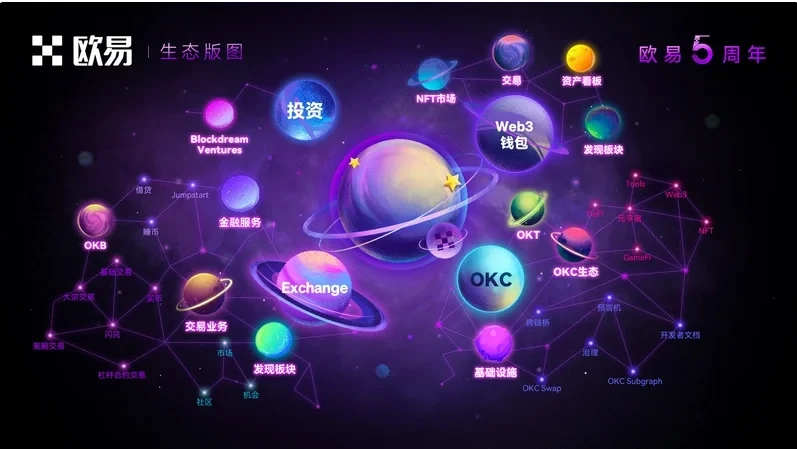
Recently, OKX—marking its 5th anniversary—released an entirely new ecosystem blueprint. After five years of growth, OKX has evolved beyond its initial CEX business to actively expand its trading business while also diversifying its digital asset product offerings, gradually building a comprehensive ecosystem encompassing the OKTC ecosystem, Web3 wallet, and crypto asset trading. Among these, the block portfolio trading platform was newly added to the trading business and is now live on the official website.
This block portfolio trading platform differs from traditional C2C block trading. Instead, it supports large-volume spot, derivatives, and multi-leg structured trading, making it one of the few block portfolio trading products available in the market. This product launch has also enabled OKX to successfully build a comprehensive and competitive ecosystem, further broadening the overall depth of the ecosystem.
First Impressions of OKX Block Portfolio Trading Platform
The OKX block portfolio trading platform targets high-net-worth individuals and professional institutions, supporting cryptocurrency asset spot trading, derivatives trading, and arbitrary portfolio combinations of multi-leg structures (i.e., coexistence of different trading instruments and two-way orders; see examples below). The platform is primarily divided into two main modules: Create RFQ and RFQ Market.
1. Create RFQ
OKX employs an RFQ (request for quote) pricing model with a built-in position builder. Users have two methods to create RFQs:
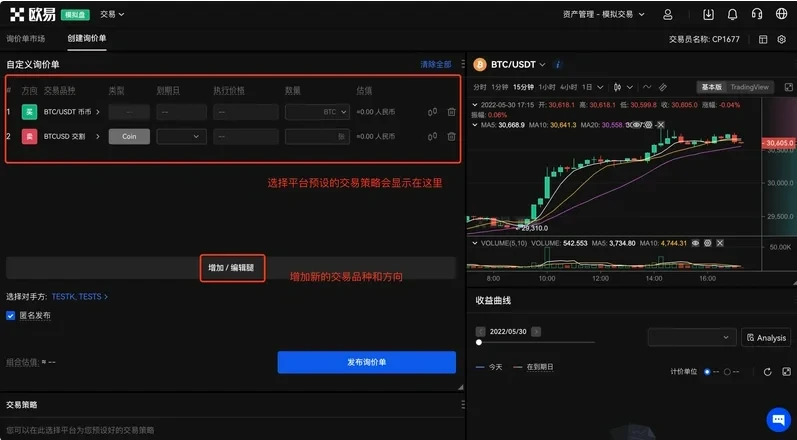
(1) Custom RFQ creation—users can select different trading instruments based on their needs, such as spot or contracts, and can also customize buy/sell direction and trading quantity.
(2) Auto-create portfolios based on multiple trading strategies provided by the platform. For user convenience and to reduce execution costs, OKX has also specifically designed a series of trading strategies. These strategies are suited for different market conditions and trading needs, aiming to help users maximize returns at minimal cost.
For easy understanding, each strategy's icon corresponds to its approximate returns curve, allowing users to preview the investment profit/loss trajectory of that strategy in advance. Institutional users can better make suitable investment choices by combining their risk preferences and trading habits.
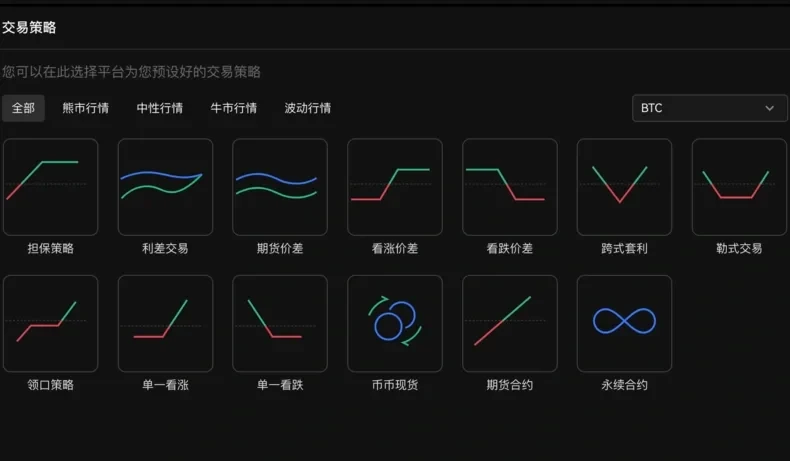
Additionally, users can add new trading instruments to their selected strategies, such as spot or contracts; and can adjust details of all "legs" according to their needs, such as expiration date, trading direction, and trading quantity.
2. RFQ Market
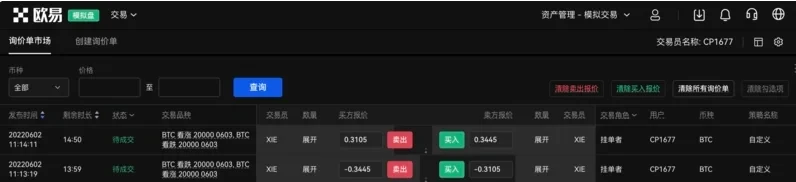
After creating an RFQ, you can view your order in the RFQ Market. The market makers' quoting system on the platform continuously provides quotes during the validity period of the RFQ. If you see a trading counterparty bidding on your order, you need to select an appropriate quote and complete the trade within the 1-minute validity period; otherwise, the quote will expire.
Based on our experience, we believe OKX's block portfolio trading platform offers comprehensive functionality that can meet diverse user needs and has the following advantages:
- RFQs support cross-business lines and cross-assets—users can meet all trading needs on a single platform.
- One-click RFQ creation with no intermediate complicated procedures, improving efficiency and saving trading time.
- Supports anonymous RFQs and two-way quotes, providing more trading options while protecting user privacy.
- Provides intelligent simulated returns and risk curves, allowing users to preview trading risks and returns in advance and prepare for strategy adjustments.
- Strong flexibility—not merely providing "exchange" services, but supporting more diversified OTC investment products.
These advantages also add finishing touches to OKX's existing product offerings.
For a long time, OKX has served retail investors and algorithmic trading teams through its in-house matching model, achieving impressive results. Now, as institutions accelerate their entry, the proportion of block trading relative to in-house spot trading will continue to rise. Exchanges like OKX can extend the block trading experience to a broader user base and simultaneously meet traders' needs for buying and selling large volumes of cryptocurrencies and derivatives.
For OKX, the launch of the block portfolio trading platform has also made it one of the few top-tier exchanges serving both retail investors and institutional clients, gaining the opportunity to compete directly with large companies specializing in serving institutional investors.
Disclaimer
This article may contain product-related content not applicable to your region. This article is only intended to provide general information and does not accept responsibility for any factual errors or omissions. This article represents only the author's personal views and does not constitute the views of OKX. This article does not intend to provide any advice, including but not limited to: (i) investment advice or investment recommendations; (ii) offers or solicitations to buy, sell, or hold digital assets; or (iii) financial, accounting, legal, or tax advice. Holdings of digital assets (including stablecoins) involve high risk and may fluctuate significantly or even become worthless. You should carefully consider whether trading or holding digital assets is suitable for you based on your financial situation. For questions specific to your circumstances, please consult your legal/tax/investment professional. The information contained in this article (including market data and statistics, if any) is for general reference purposes only. While we have taken all reasonable precautions in preparing such data and charts, we do not accept any responsibility for any factual errors or omissions expressed herein. © 2025 OKX. This article may be reproduced or distributed in its entirety, or excerpted in portions of 100 words or less, provided that such use is non-commercial. Any reproduction or distribution of the full article must prominently state: "This article is copyrighted © 2025 OKX, used with permission." Permitted excerpts must cite the article title and include attribution, for example, "Article Title, [Author Name (if applicable)], © 2025 OKX." Some content may have been generated or assisted by artificial intelligence (AI) tools. Derivative works and other uses of this article are not permitted.
Show More
Recommended Reading

2025 KOL Most-Used OKX Products Roundup
In the cryptocurrency industry, professional players' choices are always direct and pure. In 2025, KOLs cast the most authentic votes for industry tools and ecosystem development with their capital investment and time dedication throughout the year. We focused on four core questions—"What was your biggest achievement this year?", "Given your achievements, what are your most-used and favorite OKX products in 2025?", "Why do you like it?", and "This product
January 5, 2026

2026 Investment Outlook: Asset On-Chain, Intelligence & Privacy | OKX Annual Review
Three major trends for Crypto's future: asset transformation, subject transformation, and rule transformation. As we approach 2026, bidding farewell to four years of "road-building" infrastructure, the crypto industry is welcoming a profound paradigm shift. OKX Ventures defines this as the dawn of "Kinetic Finance"—where the core is no longer how fast the network is, but the liquidity and earning potential of on-chain assets
December 31, 2025

Vote with Data—A Deep Dive into 2025's Hot Trading Products | OKX Annual Review
Looking at price charts alone, it's difficult to explain the returns differences among exchange users in 2025. What truly determines returns also depends on account-level operation methods, not just market volatility itself. OKX's annual statement shows that mainstream coins remain the core for capital turnover and returns, supporting trading and strategy execution; emerging coins are more used for amplifying volatility and providing阶段性 opportunities, but are not a stable, long-term source of returns. What truly and consistently contributes to returns
December 30, 2025
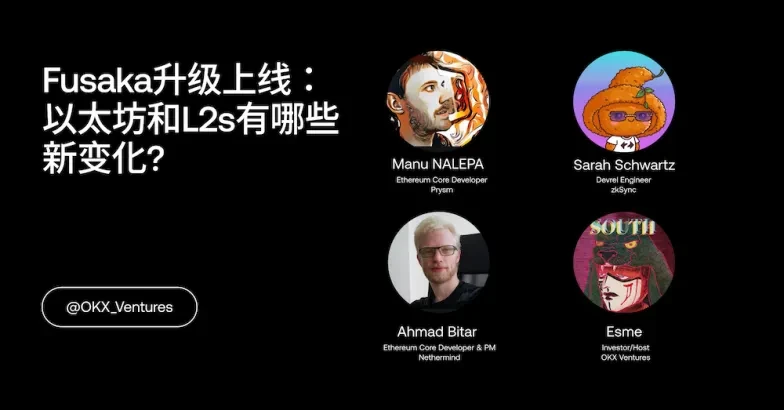
Fusaka in Practice: What Ethereum's Latest Upgrade Means for L2, Nodes, and Users
Ethereum mainnet has completed the Fusaka fork. From a protocol perspective, this upgrade primarily covers four areas. Full article with Q&A with three key guests' core viewpoints and front-line experience: Ahmad (@smartprogrammer) – Nethermind Execution Client / Ethereum Core Dev Manu (@manunalepa) – Prysm / Of
December 16, 2025
OKX Research | Why Did RWA Become a Key Narrative in 2025?
RWA (Real World Assets) is becoming the "new favorite" of global capital. Simply put, RWA involves taking valuable, ownership-bearing assets from the real world—such as real estate, bonds, stocks, and other traditional financial assets, as well as assets that are not typically easy to trade directly like artwork, private lending, and carbon credits—and bringing them onto the blockchain, transforming them into tradable, programmable crypto assets. This way, no
November 20, 2025
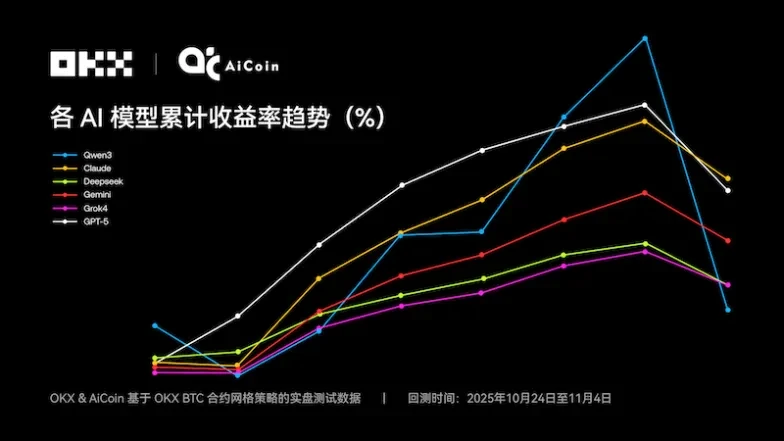
Claude Takes the Crown—6 Major AI Grid Strategy Showdown Revealed | OKX & Ai Coin Live Test
Is the short-term trading champion grid strategies? The first season of NOF1's "AI Trading Arena" finally concluded on November 4, 2025, at 6 AM, whetting the appetites of the crypto, tech, and finance communities. However, the outcome of this "AI IQ public test" was somewhat unexpected—the six models' combined initial capital of $60,000 was down to just $4.3
November 6, 2025