Generative Art Will Empower the Metaverse
META-0. 35%
On October 15, Sotheby's launched Sotheby's Metaverse, a dedicated NFT auction platform. From October 18 to 26, the platform held its first auction, featuring 53 works from 19 NFT collectors worldwide.
The top three works by auction price were: PEPENOPOULOS by Rarepepe, sold for $3.65 million, BoredApeYacht Club #8817 by Yuga Labs, sold for $3.408 million, and third place was Self Portrait #1. 2020 by Dmitri Cherniak, sold for $2.682 million. The total value of the top five most expensive auction works exceeded $12 million.
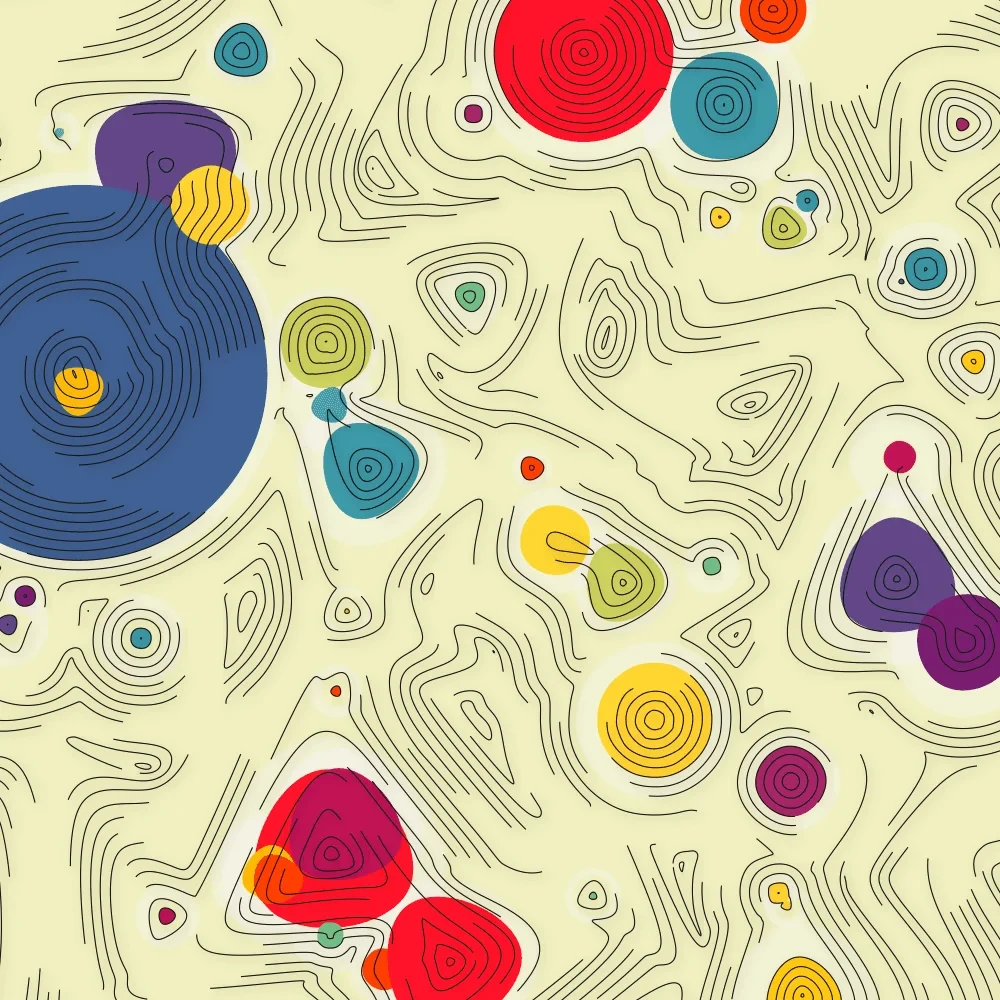
Generative crypto art Self Portrait #1. 2020 sold for $2.682 million at Sotheby's Metaverse
If the value of the top-selling PEPENOPOULOS and the second-place BoredApeYacht Club #8817 comes from the intelligent creation of crypto artists and the uniqueness and scarcity endowed by blockchain, then why is the third-place Self Portrait #1. 2020, which is simply automatically generated by computers and software—namely generative crypto art—worth a fortune? What have we overlooked behind generative crypto art?
Additionally, Facebook recently renamed itself Meta. Mark Zuckerberg, CEO of the "metaverse newcomer" Meta, published a "Founder's Letter" explaining the company's new vision for building the metaverse. What is the relationship between the metaverse and generative crypto art?
1**, Generative Crypto Art Is Not Simple**
Many people may think that generative crypto art is simply using computers for simple programming, then randomly generating certain parts of artworks, and finally piecing together colorful JPG images that appear profound but are actually useless. The reason these so-called "artworks" are worth so much money is entirely due to the catalysis of industry bubbles.
In reality, while it is undeniable that the NFT market has bubbles, the above view is the most superficial misunderstanding of generative crypto art.
The essence of generative crypto art lies in the generative artist's precise control over the size and position of randomly appearing elements in the artwork. "Control" and "randomness" may seem naturally contradictory, but under the "magic gloves" of crypto artists, the two can be perfectly and harmoniously unified in the same image.
For example, the image below is Shotter (Gravel), created by Georg Nees in 1968, considered one of the earliest and most famous generative art works. This work is characterized by Schotter starting with 12 squares placed in standard positions, and as the position moves downward, the randomness of the position and angle of gradually appearing squares begins to increase.
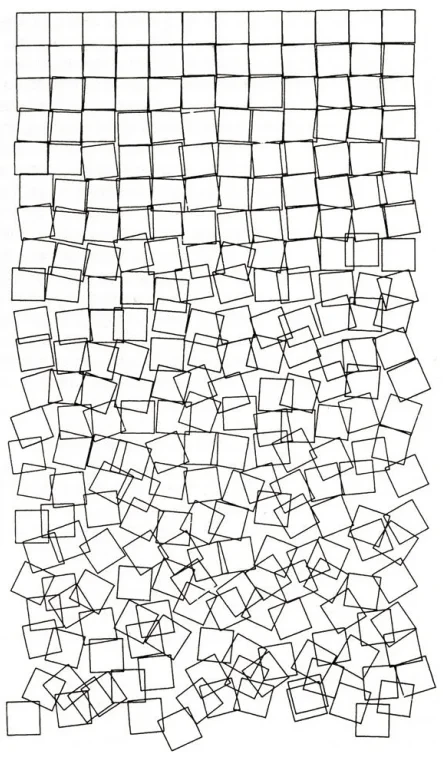
Shotter (Gravel) – Georg Nees, 1968
Imagine if you were Georg Nees, how would you complete this work according to the requirement that "the randomness of the position and angle of gradually appearing squares begins to increase"? Of course, drawing squares is something anyone can do, but the key question is how do you control the randomness of the angle and position of squares in different positions? This is difficult to accomplish manually.
However, we know that computers are best at endlessly repeating simple actions, or performing infinite calculations on a certain consensus. With this premise, as long as we give the computer a hand (printer), it can perfectly print out Shotter (Gravel), and also ensure that each printed work maintains subtle differences, because everything is random.
Isn't letting professionals do professional work exactly the essence of our industrialized social division of labor?
With this most basic understanding of generative art, let us move to the advanced level: a preliminary understanding of Self Portrait #1. 2020.
Self Portrait #1. 2020's author Dmitri Cherniak has been a major figure in the field of generative art for over 10 years. According to public information, author Dmitri Cherniak is an artist and programmer from New York whose algorithmic art has been exhibited in galleries and exhibitions in New York, San Francisco, and Miami. His recent work Ringers (2021) generated algorithmic versions of 1,000 unique images on Art Blocks. Dmitri also views automation as his primary artistic medium.
Dmitri chose "automation" as the medium for his artistic realization. While non-technical people may think automation represents boring, dull, and robotic work, Dmitri insists on his choice. In Dmitri's view, automation itself is far more creative than public perception.
The introduction of automated creation enables him to automatically generate unique artworks in less than a fraction of a second.
The generative crypto art Self Portrait #1. 2020, which sold for $2.682 million at Sotheby's Metaverse, is the most important work of Dmitri's career. What makes this work special is that creating something creative that resembles yourself without using original images requires incredible skill and patience. This is what Dmitri has achieved, and no one else can match it.
During the creative process, Dmitri needed to go through hours of iterating shapes and parameters, patching algorithms, with "random" ideas everywhere throughout the process. For example, Dmitri saw himself in randomly collected circles, curves, colors, and lines, even his green eyes staring back at him.
In summary, generative art is not formed by random computer scribbling, which is no different from unconscious children's doodles. The generative crypto art created by artists contains their reflections on art, psychology, algorithms, color, and ideology. These factors combine to manifest through the form of crypto art, ultimately earning considerable bids.
2**, Falling in Love with Generative Crypto Art**
Just as NFTs can have various art forms, generative art also has diverse forms of expression, and generative crypto art also has a certain "playability".
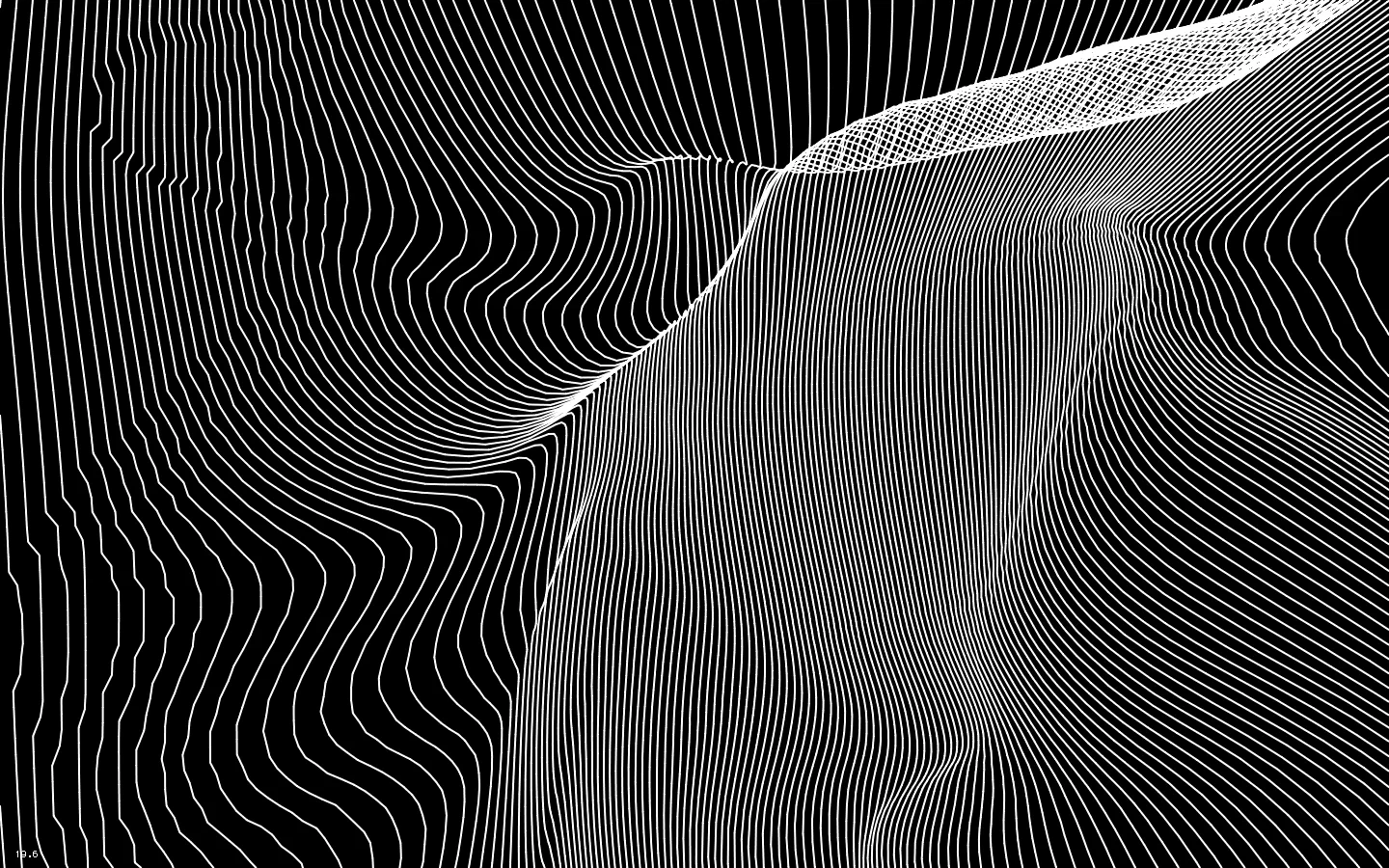
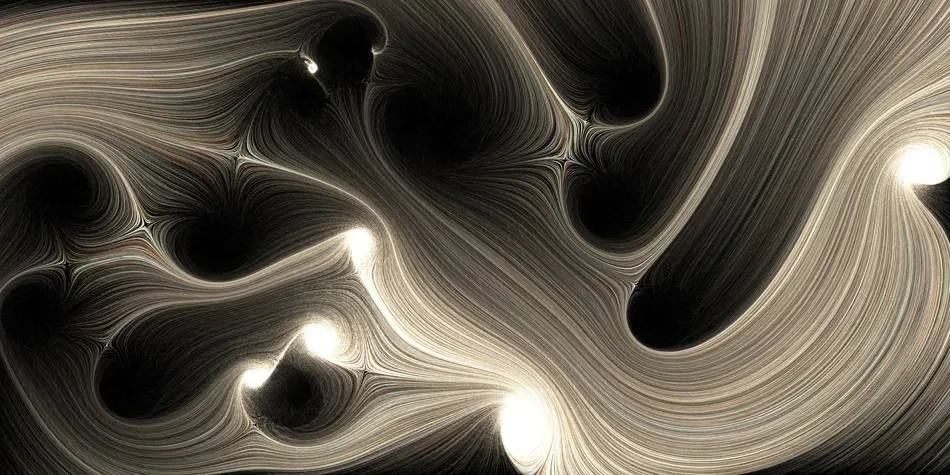
Take Art Blocks as an example. Unlike profile picture NFTs which typically have a fixed quantity of 10,000, Art Blocks series generally have a limit of one thousand or several hundred works. Another major difference from profile picture NFTs is that buyers don't know what specific work they will receive before minting generative artworks. It could be any of the following forms, and they can only make a rough inference based on the appearance of other works in the series. This is also why generative art has strong scarcity and randomness, and is one of the main reasons attracting many players to purchase.
Additionally, participants can also explore infinitely in a certain field according to their preferences. For example, artists can not only explore visual images but also explore the video and audio fields.
In early October this year, generative artist 0xDEAFBEEF was interviewed by JPG co-founder Sam Spike. Sam Spike asked, how do you view the relationship between audio and images?
0xDEAFBEEF believes that from a personal experience perspective, he seeks difference, sometimes pursuing visual effects first, then finding complementary sounds. 0xDEAFBEEF stated that when he started sharing on Instagram, he quickly realized that to get people to notice audio, there must be visual elements. In visually dominated social media, sound is difficult to notice. People can scroll through images, but music requires time to stop and listen.
Additionally in the interview, Sam Spike also talked about the relationship between generative art and the metaverse.
0xDEAFBEEF believes that current metaverse VR worlds are all manually completed, which is very time-consuming. Procedural design tools are already very common in "real life," such as industrial design, architecture, and game design. The addition of generative art ideas will free designers from the tedium of repetitive work.
In other words, generative art is not only fun and has infinite exploration space, but can also empower the metaverse concept.
Recently Facebook renamed itself Meta. Mark Zuckerberg, CEO of the "metaverse newcomer" Meta, published a "Founder's Letter" explaining the company's new vision for building the metaverse. At the same time, he stated, "Our mission hasn't changed, still to bring people together."
This may ignite global investors' enthusiasm for the metaverse concept, and the addition of generative art may also improve work efficiency, making the metaverse world more colorful.
In summary, generative crypto art is far more than simple automatic JPG printing, but an excellent tool for improving art creation efficiency and a handle for building the metaverse.
Disclaimer
This article may contain product-related content that is not applicable to your region. This article is intended to provide general information only and does not take responsibility for any factual errors or omissions therein. This article represents only the author's personal views and does not represent the views of OKX. This article is not intended to provide any advice, including but not limited to: (i) investment advice or investment recommendations; (ii) offers or solicitations to buy, sell, or hold digital assets; or (iii) financial, accounting, legal, or tax advice. Holding digital assets (including stablecoins) involves high risk, may fluctuate significantly, and may even become worthless. You should carefully consider whether trading or holding digital assets is suitable for you based on your financial situation. For questions about your specific situation, please consult your legal/tax/investment professional. The information appearing in this article (including market data and statistics, if any) is for general reference only. Although we have taken all reasonable precautions in preparing these data and charts, we assume no responsibility for any factual errors or omissions expressed herein. © 2025 OKX. This article may be reproduced or distributed in its entirety, or excerpts of 100 words or less from this article may be used, provided that such use is non-commercial. Any reproduction or distribution of the entire article must also prominently state: "This article copyright © 2025 OKX, used with permission." Permitted excerpts must cite the article name and include attribution, such as "Article Name, [Author Name (if applicable)], © 2025 OKX". Some content may be generated or assisted by artificial intelligence (AI) tools. Derivative works or other uses of this article are not permitted.
Show More
Recommended Reading

2025 KOL Most Used OKX Products List
In the cryptocurrency industry, professional players' choices are always direct and pure. In 2025, KOLs invested a full year of funds and time to cast the most authentic vote for industry tools and ecosystem development. We focused on four core questions—"What was the biggest achievement this year?", "Under the premise of achieving results, what OKX products did you use most and like best in 2025?", "Why do you like it?", "This
January 5, 2026

2026 Investment Outlook: Assets On-Chain, Intelligence and Privacy | OKX Annual Review
Three major trends in Crypto's future: Asset transformation, entity transformation, and rule transformation. As we are about to enter 2026, saying goodbye to the past four years of infrastructure focused on "building roads," the crypto industry is welcoming a profound paradigm shift. OKX Ventures defines this as the opening of the "Kinetic Finance" era, where the core is no longer how fast the network is, but the flow and earnings of on-chain assets
December 31, 2025

Voting with Data:透视 2025 Hot Trading Products | OKX Annual Review
If you only look at market conditions, it's difficult to explain the return differences between trading users in 2025. What truly determines returns also depends on account-level operation methods, not just market volatility itself. OKX's annual statement shows that mainstream coins are still the core of fund turnover and return bearing, supporting trading and strategy execution; emerging coins are more used to amplify volatility and provide phased opportunities, but are not stable, long-term return sources. What truly continuously contributes returns,
December 30, 2025
Fusaka in Practice: What Does Ethereum's Latest Upgrade Mean for L2, Nodes, and Users?
Ethereum mainnet has completed the Fusaka fork. From the protocol level, this upgrade mainly includes four parts. The full text presents the core viewpoints and first-line experience of the three guests in Q&A format: Ahmad (@smartprogrammer) – Nethermind execution client / Ethereum core developer Manu (@manunalepa) – Prysm / Of
December 16, 2025
OKX Research | Why Did RWA Become a Key Narrative in 2025?
RWA (Real World Assets) is becoming a global capital "new favorite." Simply put, RWA takes valuable, ownership-bearing things from the real world—such as traditional financial assets like houses, bonds, stocks, as well as assets that are usually difficult to trade directly like artworks, private lending, carbon credits—and moves them onto the blockchain to become tradable, programmable crypto assets. This way, not
November 20, 2025
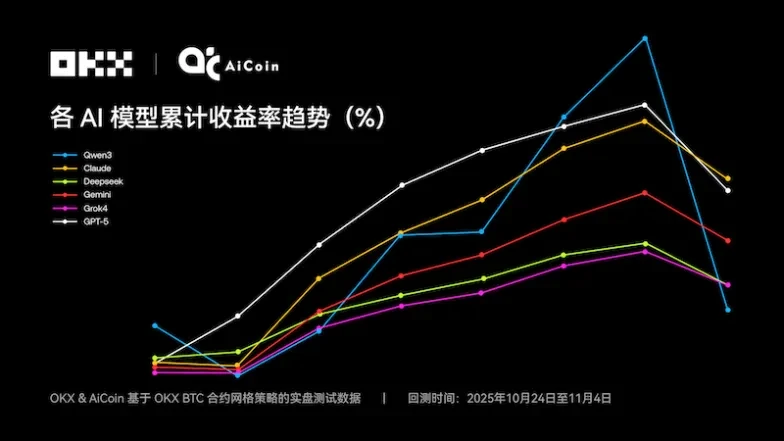
Claude Takes Championship, 6 Major AI Grid Strategy Showdown Truth | OKX & Ai Coin Live Test
Short-term trading champion Qwen3, is it also king in grid strategies? The first season of the "AI Trading Live Arena" launched by NOF1 finally concluded at 6 AM on November 4, 2025, whetting the appetites of the cryptocurrency, technology, and financial circles. But the ending of this "AI IQ public test" was somewhat unexpected. The total principal of $60,000 across six models was only $4.3 left at the end
November 6, 2025