
Market in Volatility as "Global Rate Hike Wave" and Fed Decisions Loom
Beijing Time, March 17 (this Thursday) at 2:00 AM tomorrow, the much-anticipated second Federal Reserve policy meeting of 2022 will conclude. The Fed will announce the results of its March meeting: interest rate decision, policy statement, and economic projections, followed by a press conference with Fed Chair Powell.
For this Fed meeting, the one point the market agrees on without dispute is that the rate hike cycle will officially begin. This means that the Fed's first rate hike in over three years—since the 2018 rate increases—is truly arriving. The only uncertainty is the magnitude of the hike and the subsequent path of rate hikes. Beyond the rate decision itself, guidance on "balance sheet reduction," the impact of the Russia-Ukraine situation, and other economic data are also worth watching.
Additionally, as a "super central bank week," not only will the Fed begin raising rates, but the Bank of England may also hike by 25 basis points this week, Brazil's central bank is expected to hike by 100 basis points, and Russia, which emergency-hiked by 1,050 basis points, will also be in the global spotlight with its statement this week. Moreover, the central banks of Indonesia, Turkey, and Japan will announce rate decisions. A global wave of rate hikes seems inevitable.
If this rate hike expectation materializes, will it be bearish or bearish-news-turned-bullish for the crypto market? This is what investors are most concerned about. Currently, both trading volume and price volatility have extremely contracted—it can be said we've reached another juncture of seeking direction. So, with the Fed rate hike about to land, what should investors watch for in the market?
Market Review: Endless Declines—Why Did Bitcoin Get Cut in Half?
Counting from November 10 last year when Bitcoin hit its all-time high of $69,040, Bitcoin's continuous decline has lasted 4 months and 7 days. The maximum drop so far exceeds 52% (OKX data, same below), while Ethereum is down 55.6%, and some digital assets have fallen over 90%—it can be called a completed deep cleansing. During the decline, although there have been single-day gains of over 10%, they were immediately suppressed by the market, falling right back from where they rose—quite displaying the "bull markets have violent rallies, then continue falling" pattern. Other digital assets fell even harder than Bitcoin. Bearish sentiment in the market is almost "unanimously dominant," with bulls few and far between, huddled in corners trembling.
If we review with hindsight, what are the reasons for the market's endless declines and Bitcoin being cut in half? What patterns will the market show going forward?
From the crypto market's perspective itself, after the successive explosions of hot concepts and projects like DeFi, NFT, GameFi, Metaverse, and public chains, market funds have entered a "post-clarity sage mode." Coupled with concerns about the deteriorating macro environment, the sentiment to "secure profits" is strong. This explains why after "5.19," Bitcoin and Ethereum hit new highs, while most other digital assets only saw tokenistic gains before now falling even harder. After rapid development, the crypto market is now entering a bubble-squeezing phase—only after优胜劣汰 will it enter another explosive growth phase.
From Bitcoin's own perspective, Bitcoin remains the largest entry channel for outside funds. Although its absolute dominance has somewhat shaken, its role as a wind vane remains irreplaceable. So now there's a core question to explore: Is Bitcoin a risk asset or a safe-haven asset? This determines whether funds in Bitcoin's pool will increase or be first withdrawn when rate hikes begin, thereby largely determining the basic form of the entire crypto market.
Bitcoin has existed for thirteen years. Over these thirteen years, Bitcoin has been a story of continuously growing users and overall rising prices. During these thirteen years, in the real world, central banks led by the Fed have been printing money at even more exaggerated speeds. Currently, they're even accelerating money printing based on theories like "Modern Monetary Theory (MMT)." The core idea of Modern Monetary Theory is: fiat currency is a government tool for economic regulation—zeros can be added at will. Governments can borrow without needing to repay—just print more money.
Understanding Bitcoin's birth background and its origin in the Cypherpunk group, one knows the true reason and significance of Bitcoin's birth. As the culmination of the concept opposing monetary control of people and the pinnacle of social experimentation, Bitcoin is like a mirror image of the real-world Fed. As long as the Fed keeps printing money, using new debt to pay old, Bitcoin will continue growing. From this perspective, Bitcoin's safe-haven attribute relative to the real world is fundamentally valid.
However, everyone who has studied materialist dialectics knows that the growth of new things takes time, and the road is twisted. People's understanding of new things also takes time. Bitcoin is now only thirteen years old, just entering adolescence. Adolescence is passed through volatility and wild growth methods. The Bitcoin shown now undoubtedly behaves more like a risk asset. Every time there's slight wind or grass movement, it falls deeper than US stocks, gold, and other markets. Yet adolescent body recovery and growth capabilities are unparalleled. Even if it falls and bleeds a bit each time, it heals quickly. As long as external nutrition keeps up, growth remains vigorous.
As a just-adolescent Bitcoin, this market cycle has just been recognized and accepted by mainstream institutions, funds, and even sovereign nations. The external nutrition—the Fed's money printing—is currently sufficient. Even if subsequent rate hikes land and it performs like a risk asset, being rapidly drained and falling sharply, it's unlikely to repeat the deep, long bear markets after the previous two halving cycles. Moreover, due to the Fed's massive money printing during the pandemic and the performance of the traditional financial system during the Russia-Ukraine war, Bitcoin's safe-haven attributes—especially as a hedge against real-world risk—will be increasingly recognized, truly growing into "digital gold."
From the macro environment perspective, although the current market environment doesn't support a deep bear market, the disastrous consequences caused by previous Fed rate hike and balance sheet reduction cycles create fear in many. This fear emotion hasn't been fully released yet, making it difficult to regain upward momentum. If this meeting initiates rate hikes, it may be a concentrated major release of this fear. The greater the fear released, the higher the subsequent rebound may be. Of course, historical experience also tells us that after the Fed begins rate hikes and balance sheet reduction, we need to guard against black swan events and systemic risks from rapid large-scale liquidity withdrawal.
Global Rate Hikes: What Should Investors Watch?
With the Fed's rate hike about to land, the UK, Brazil, Russia, Japan, Turkey, and other countries have also either started or are about to start rate hikes. Under this global wave of rate hikes, will it become an accelerator for a global financial crisis? What do we need to watch?
Currently, the most important thing to watch is still: how the Fed's rate hike lands tomorrow. This includes the rate decision, policy statement, economic projections, "balance sheet reduction" guidance, impact of the Russia-Ukraine situation, etc.
For tomorrow's announcement of the meeting results, special attention is needed to how many basis points the rate hike will be and how the subsequent rate hike path is described. Fed Chair Powell stated in a recent speech that he expects a series of rate hikes this year, and the US economy can withstand the Fed's actions. He believes a 25 basis point hike in March is appropriate. If inflation remains hot, the Fed is prepared to take more aggressive action in one or more meetings—that is, a 50 basis point hike.
Currently, important consensus has been reached within the Fed to begin the monetary policy normalization process with a 25 basis point "standard mode." However, the risk of accelerating inflation may keep the option of aggressive future rate hikes open. If subsequent aggressive rate hikes occur, they could rapidly drain liquidity from all markets, including the crypto market, which would undoubtedly be a catastrophic blow.
Regarding balance sheet reduction, Powell previously revealed that the Fed will gradually reduce asset holdings after rate hikes begin, but the reduction will proceed "in a predictable manner." "We hope to make progress on the balance sheet reduction plan in March. This meeting will not determine the balance sheet reduction plan." The Fed's current total balance sheet holdings have reached as high as $9 trillion, double that before the pandemic.
As we stated in our previous article "Fed Rate Hikes (Part 3): Balance Sheet Reduction is the Real Beginning of the Crash and the End of the Bull Market", compared to rate hikes, balance sheet reduction is the true "bear's ultimate move," so special attention is needed to Powell's comments on balance sheet reduction tomorrow. Current market analysis suggests: although discussions within the Fed this year about balance sheet reduction timing, scale, and composition have significantly increased, under current economic conditions, the FOMC may need to wait until the July meeting to announce the start of balance sheet reduction.
Because the impact of the Russia-Ukraine war on the global economy is becoming increasingly apparent, especially directly causing violent price fluctuations in global commodities like oil and natural gas, both the resolution statement and Powell's latest responses at the press conference deserve close attention. Currently, some investors in the market believe the combination of war, high inflation, and rate hikes is full of risk. This may trigger a global financial crisis, or even disastrous consequences, once again causing a major decline like March 12, 2020, or even crashing the entire crypto market.
Additionally, at this meeting, the Fed will update its Summary of Economic Projections (SEP). Data on economic growth, inflation, unemployment rate, and median federal funds rate will be adjusted. These data may set the tone for the pace of future rate hikes, affecting not only the 2022 rate hike rhythm but potentially Fed monetary policy for the next three years.
In this "super central bank week," beyond the Fed meeting, the Bank of England will hold its March rate meeting on March 17 local time, and the Bank of Japan will meet March 17-18. Related results are also worth investors' attention.
If the Fed rate hike lands tomorrow, other countries will likely follow suit, potentially causing chain reactions, especially black swan events. We have already discussed in detail the possible changes in the economic environment caused by rate hikes in our previous article "Fed Rate Hikes (Part 4): How They Affect Crypto Market Rise and Fall and Bull-Bear Transitions?".
Currently, most risks are still in a dormant phase, waiting for the rate hike "fuse" to detonate them. Due to global super money printing since the pandemic, accumulated risks have almost reached a critical point of explosion. Moreover, because economic development levels and quality vary, the explosion of some risks is almost inevitable—the remaining questions are where will explode first, how will it explode? And do the relevant countries/regions have contingency plans and the ability to suppress it after explosion?
Finally, considering current factors, if the rate hike lands tomorrow, it may cause significant short-term market volatility. However, because the market has digested rate hike expectations relatively fully, coupled with continuous declines over the past 4 months and relatively adequate bubble squeezing, and because Fed rate hikes take time to transmit to markets, we cannot exclude the possibility of bearish-news-turning-bullish after the rate hike. From a long-term impact perspective, the strength and speed of Fed rate hikes, the resulting changes in the macroeconomic environment, and the quality of the crypto market's own development will be the core factors ultimately determining market rise and fall and the major bull-bear direction for this year and even until Bitcoin's fourth halving in 2024.
Disclaimer
This article may contain content related to products not available in your region. This article is intended only to provide general information and is not responsible for any factual errors or omissions herein. This article represents only the author's personal views and does not represent OKX's views. This article is not intended to provide any recommendations, including but not limited to: (i) investment advice or investment recommendations; (ii) offers or solicitations to buy, sell, or hold digital assets; or (iii) financial, accounting, legal, or tax advice. Holding digital assets (including stablecoins) involves high risk, may fluctuate significantly, and even become worthless. You should carefully consider whether trading or holding digital assets is suitable for you based on your financial situation. For questions about your specific situation, please consult your legal/tax/investment professional. The information appearing in this article (including market data and statistics, if any) is for general reference only. Although we have taken all reasonable precautions in preparing these data and charts, we assume no responsibility for any factual errors or omissions expressed herein. © 2025 OKX. This article may be reproduced or distributed in full, or excerpts of 100 words or less from this article may be used, provided such use is non-commercial. Any reproduction or distribution of the entire article must also prominently state: "© 2025 OKX. Used with permission." Permitted excerpts must cite the article name and include attribution, for example "Article Name, [Author Name (if applicable)], © 2025 OKX". Some content may be generated or assisted by artificial intelligence (AI) tools. Derivative works or other uses of this article are not permitted.
Show More
Recommended Reading

2025 KOLs' Most Used OKX Products: A Comprehensive Overview
In the cryptocurrency industry, professional players' selections are always direct and pure. In 2025, KOLs voted with a full year of fund input and time accumulation for the most authentic ballot on industry tools and ecosystem development. Centered around four core questions—"What was the biggest achievement this year?", "Given those achievements, what OKX products did you use most and love most in 2025?", "Why do you like it?", and this
January 5, 2026

2026 Investment Outlook: Asset On-Chain, Intelligence and Privacy | OKX Annual Review
The three major trends of crypto's future: asset transformation, entity transformation, and rule transformation. As we approach 2026, bidding farewell to the past four years of infrastructure-focused "road-building," the crypto industry is welcoming a profound paradigm shift. OKX Ventures defines this as the opening of the "Kinetic Finance" era—where the core is no longer how fast the network is, but the flow and earnings of on-chain assets
December 31, 2025

Voting with Data: Insights into 2025's Popular Trading Products | OKX Annual Review
Looking only at market conditions makes it difficult to explain the return differences among trading users in 2025. What truly determines returns also depends on account-level operational methods, not merely market volatility itself. OKX's annual statement shows that mainstream coins remain the core of fund turnover and return carrying, supporting trading and strategy execution; emerging coins are more used to amplify volatility, providing阶段性 opportunities but are not stable, long-term return sources. What truly continuously contributes returns is,
December 30, 2025

Fusaka in Practice: What Does Ethereum's Latest Upgrade Mean for L2s, Nodes, and Users?
Ethereum mainnet has completed the Fusaka fork. At the protocol level, this upgrade mainly includes four components. The full text presents the core views and frontline experience of three guests in Q&A format: Ahmad (@smartprogrammer) – Nethermind execution client / Ethereum core developer Manu (@manunalepa) – Prysm / Of
December 16, 2025

OKX Research | Why Did RWA Become a Key Narrative in 2025?
RWA (Real World Assets) is becoming a global capital "new favorite." Simply put, RWA means taking valuable, ownership-bearing things from the real world—like houses, bonds, stocks and other traditional financial assets, or even assets not easily traded directly like artwork, private lending, carbon credits—and moving them onto blockchain to become tradable, programmable crypto assets. This way, not
November 20, 2025
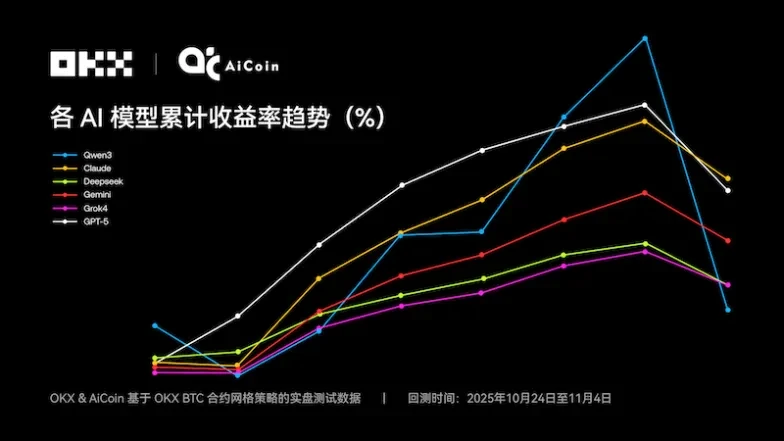
Claude Takes the Championship: Truth Behind 6 Major AI Grid Strategy Showdown | OKX & Ai Coin Live Trading Review
Short-term trading champion Qwen3—is it also king in grid strategies? The first season of NOF1's "AI Trading Live Arena" finally concluded at 6 AM on November 4, 2025, whetting the appetites of the crypto, tech, and finance circles. But the ending of this "AI IQ public test" was somewhat unexpected: the six models' total principal of $60,000 was only $4.3
November 6, 2025