Where Are Decentralized Assets Safest Stored? This Article Has the Answer
As Silicon Valley Bank and others接连暴雷, the entire traditional financial industry has been deeply impacted, once again exposing major flaws in centralized financial systems—namely, the transparency and security issues inherent in centralization, which remain unresolved even in such a critical financial system as the US banking sector.
The solution to this problem is precisely why Bitcoin's financial system and decentralized finance were created. As the "banking crisis" intensifies, the crypto world presents a vastly different picture: after a brief dip, the market quickly recovered, surging nearly 20 points intraday, which is not unrelated to the renewed hope people see in decentralized finance: funds on-chain are transparent, can be managed using self-custody wallets like OKX Web3 Wallet, and even on exchanges, fund safety can be ensured through regular POR audits on platforms like OKX.
So if you want to participate in decentralized finance, where should you store your decentralized assets? Where is the safest and most convenient place? This article tells you the answer.
1. Where Should Decentralized Assets Be Stored?
Typically, crypto users store their digital assets through two channels: centralized exchanges and digital wallets.
A considerable number of users consider centralized exchanges their first choice. After all, the purpose of acquiring assets is to make them appreciate, and to appreciate, you must trade. Centralized exchanges offer a better trading experience and allow users to earn interest on their assets at the same time, making the overall experience highly convenient.
However, some centralized exchanges with opaque funds may have asset safety issues, such as misuse of user principal or inability to process withdrawals during a bank run. Recently, incidents at a major exchange have shaken the entire market, with many users rushing to withdraw their assets from various centralized exchanges.
In this situation, people can't help but ask: where is the safest place to store assets? We believe that if you prioritize trading convenience, you can keep your assets on exchanges with transparent funds; if you prioritize long-term holding, then you can store them in a decentralized digital wallet.
Only Exchanges with Transparent Funds Are Trustworthy:
As mentioned earlier, the advantage of storing assets on centralized exchanges is that it facilitates trading operations and shortens the path for fund transfers. However, the biggest risk of storing assets on centralized exchanges is opacity—specifically, whether the platform has misappropriated user deposits and to what extent.
Therefore, after the incident at a certain exchange, OKX and other leading exchanges officially stated that they would use a solution based on the Merkle Tree technical framework to prove that platform assets exceed liabilities, ensuring user safety.
Simply put, according to the Merkle Tree framework, user deposits—i.e., the exchange's liabilities to users—are all incorporated into a meticulous, hierarchical, and complex statistical structure. Once computation begins, all user deposit amounts will be accurately tallied, with no possibility of omission or miscalculation. The final total liability will then be compared against the exchange's total on-chain assets. If assets exceed liabilities, the exchange's financial condition is healthy and trustworthy. Conversely, it would be disastrous.
For a detailed explanation of how Merkle Tree proves that an exchange can 100% redeem user deposits, the OKX新手学院 (Novice Academy) has already provided a comprehensive analysis in a previous article. For details, please click 《Quick Guide: How Merkle Tree Verifies Whether a CEX Has 100% Reserve Funds》.
OKX was the first in the entire industry to take the initiative and adopt the Merkle Tree mechanism among leading exchanges. This openness and willingness to self-certify demonstrate OKX's confidence in asset safety, and never touching user funds is its core operating principle. Additionally, since its founding in 2013, OKX has nearly a decade of development history, having weathered multiple bull and bear cycles and experienced numerous significant trials. These factors are more than enough to prove that users can confidently deposit their assets with OKX.
Analysis of the Advantages and Disadvantages of Storing Assets in Digital Wallets:
Digital wallets are also a popular choice for storing assets. They are divided into cold wallets and hot wallets. The former never connects to the internet, meaning in theory it has a higher security coefficient—the user's private keys are naturally isolated from the internet, and external parties cannot steal them over the network.
Cold wallets include paper wallets, brain wallets, and hardware wallets, which store the user's private keys on paper, in the user's memory, or on offline phones and computers, respectively.
However, this method is inconvenient to manage because private keys are long strings of numbers and letters, so many cold wallet users easily lose their private keys, only to regret it later. At the same time, cold wallets have very poor interactivity—users need to repeatedly switch assets to other platforms, such as exchanges or hot wallets.
Therefore, for users who frequently trade assets and transfer funds, cold wallets are not a particularly ideal choice. But what if internet-connected hot wallets aren't secure enough? What if the hot wallet platform owner or hackers steal my private key and promptly withdraw my assets? Is there a hot wallet that can match the security of cold wallets?

OKX Web3 Wallet does exactly this. OKX Web3 Wallet is a multi-functional decentralized wallet. Here, let us explain what a decentralized wallet is: it does not store the user's private keys and seed phrases, but instead fully entrusts this core secret to the user.
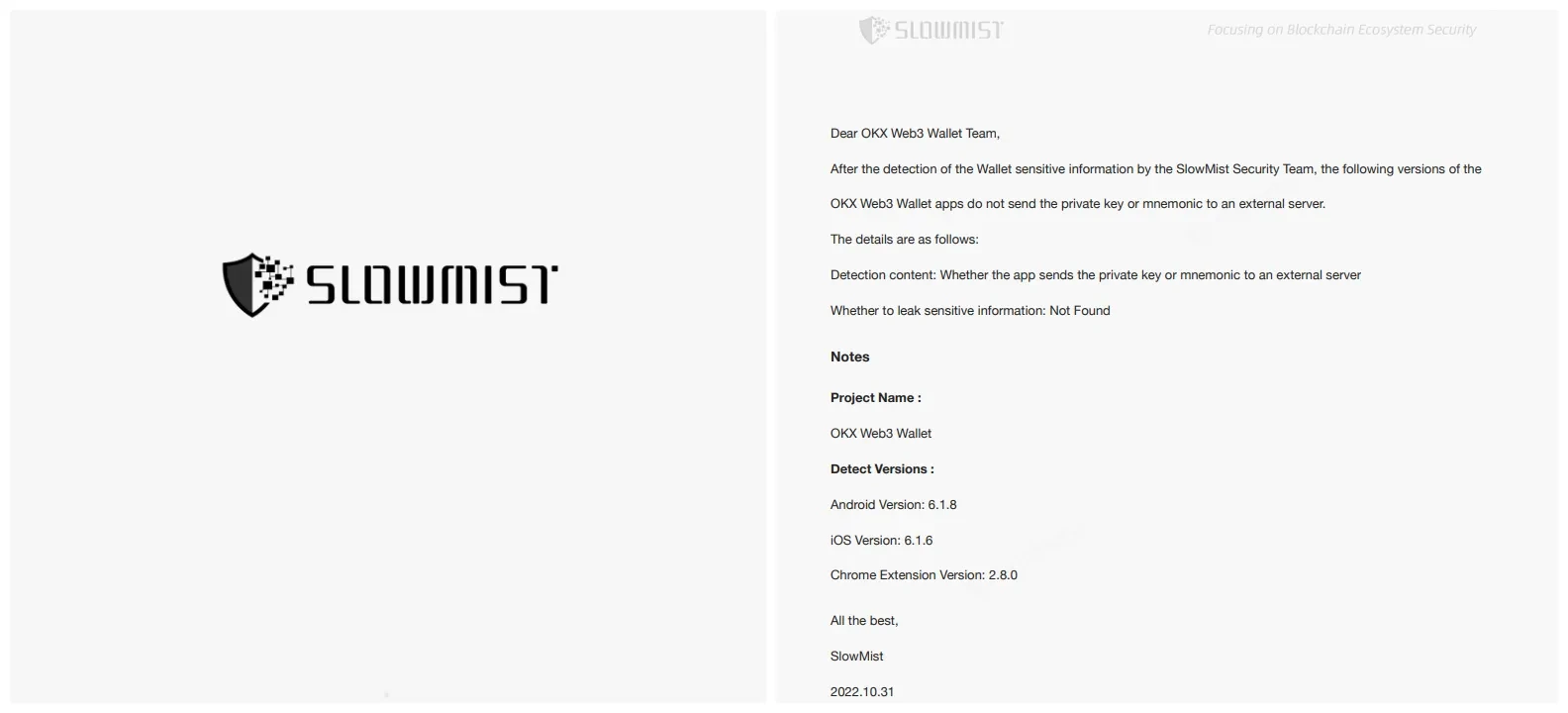
Before the incident at a certain exchange, OKX Web3 Wallet had already passed a private key security audit by SlowMist. The audit results confirmed that private keys or seed phrases are only stored on user devices, and OKX Web3 Wallet does not send private keys or seed phrases to external servers. In other words, from both practical and theoretical perspectives, the private keys of OKX Web3 Wallet users can only be controlled by the users themselves, and external networks cannot access them under any circumstances—unless the user voluntarily discloses them to others, or the phone is stolen and the thief retrieves the private key.
In Summary:
The incident where major players collapsed and ordinary users were caught in the fallout has chilled everyone. However, it should be noted that despite the high volatility and risks in the crypto space, there are still evergreen players, and OKX is a prime example. There are many ways to deal with black swans and gray rhinos. OKX's core principles in protecting user asset safety include the following:
Never touch user assets; ensure full redemption. Protect user privacy; prevent private key leakage. Strengthen technical foundations; reinforce network security. User interests come first; risk prevention and control take top priority.
Disclaimer
This article may contain product-related content not applicable to your region. This article is only committed to providing general information and does not responsible for any factual errors or omissions herein. This article only represents the author's personal opinions and does not represent OKX's views. This article does not intend to provide any of the following advice, including but not limited to: (i) investment advice or investment recommendations; (ii) offers or solicitations to buy, sell, or hold digital assets; or (iii) financial, accounting, legal, or tax advice. Holding digital assets (including stablecoins) involves high risk, may fluctuate significantly, or may even become worthless. You should carefully consider whether trading or holding digital assets is suitable for you based on your financial situation. For questions about your specific circumstances, please consult your legal/tax/investment professionals. The information contained in this article (including market data and statistics, if any) is provided for general reference purposes only. Although we have taken all reasonable precautions in preparing such data and charts, we do not accept any responsibility for any factual errors or omissions expressed herein. © 2025 OKX. This article may be reproduced or distributed in its entirety, or excerpts of 100 words or less may be used, provided that such use is non-commercial. Any reproduction or distribution of the full article must prominently state: "This article is copyrighted © 2025 OKX, used with permission." Permitted excerpts must cite the article title and include attribution, e.g., "Article title, [author name (if applicable)], © 2025 OKX." Some content may have been generated or assisted by artificial intelligence (AI) tools. Derivative works or other uses of this article are not permitted.
Show More
Recommended Reading
How Does OKX Keep Your Crypto Assets Safe?
At OKX, security is our top priority, and we are committed to providing you with a safe and reliable crypto trading experience. From data protection to system stability, we employ multiple measures to ward off threats and protect your crypto assets. With advances in artificial intelligence and other technologies, we have brought you new platform security solutions. Overview OKX collaborates with security firms like Certi K to discover and fix vulnerabilities, making trading safer. Advanced technology
2026年2月19日
How to Protect Your OKX Assets with 2FA and Other Security Measures?
The core of securing digital assets lies in protecting your account. Account security is directly related to asset protection. Just as risk management safeguards trading funds, ensuring account security is the highest level of asset protection. At OKX, we prioritize account security and asset protection, committed to helping users monitor, safeguard, and strengthen account and asset security. However, the best security requires your active participation, as you are the primary responsible party for your account
2026年1月19日
How Does OKX Protect Your Crypto Assets and Enhance Account Security?
Overview OKX's Proof of Reserves (PoR) ensures assets are fully transparent and fully reserved. Cold wallets store assets offline, away from internet-connected risks. Multi-signature wallets require multiple authorizations, ensuring trading security. The margin mechanism can provide additional protection against market risks encountered in trading. On-chain risk detection intercepts suspicious activities; token detection tools identify high-risk tokens. Proof of Reserves O
2026年1月16日
How Does OKX's Cybersecurity Defense Unit Protect Your Account Security?
As technology continues to evolve, threats against digital platforms are also increasing. OKX's Cybersecurity Defense Unit is our front-line force, dedicated to staying ahead of security challenges and providing a safe environment for all platform users. Below is our new security solution and how our cybersecurity team works to protect you and your crypto assets. Overview World-class experts form OKX's first line of defense. Staying ahead through simulated attacks.
2025年3月4日
Five Tips for Protecting Yourself from Social Engineering Attacks
Social engineering exploits human psychology, turning trust and urgency into vulnerabilities. While technical defenses are crucial, true security requires awareness and proactive action. We empower you through education and technology. Here is how you can protect yourself from social engineering attacks. Overview Stay vigilant about unexpected messages; think twice before clicking links or opening attachments. Be mindful of what you post online; limit sharing personal information. Avoid on public
2025年2月27日

【Tutorial】How to Use OKX's Proof of Reserves Feature? Verify Asset Safety in a Few Simple Steps
OKX is a company that places great emphasis on fund transparency and adheres to its commitment to asset transparency. To ensure that user assets have 100% fund reserves on the OKX platform, OKX announced the enhancement of user asset safety and transparency through Proof of Reserves (PoR). On the afternoon of November 23, OKX officially launched Proof of Reserves (Proof of Reserves, hereinafter referred to as PoR). Simply put, the PoR function is a
2024年4月25日